Can a classical machine out-optimise a quantum one?
Every "quantum will revolutionise optimisation" headline has a classical rival built on the same underlying physics: coupled circuits settling into the answer, not calculating it. Meet the machine it has to beat.
You'll be able to say when a classical or analog machine beats a quantum one on an optimisation problem.
The answer in four lines
An Ising machine is a physical network engineered so its own natural resting state is the answer to an optimisation problem: not calculated, arrived at. Wire many oscillators, lasers, or fluctuating bits together with couplings that encode a problem, and the network relaxes toward the minimum of an energy function called the Ising Hamiltonian, the exact same object a quantum annealer is built to minimise, reached by an entirely classical route. Three real hardware families compete on this today, one of them now running at a million-unit scale, and none of them wins every problem: which one is best depends on the instance, not the marketing.

The trick: don't calculate the answer, build something that settles into it
Tip a tray full of marbles onto a warped sheet and walk away. You didn't compute where they'd end up; you shaped the sheet, and physics did the rest. Every marble rolls downhill until it can't roll any further, and the resting positions are, in a real sense, the "answer" to "where is lowest here?" Nobody ran an algorithm. The shape of the sheet was the algorithm.
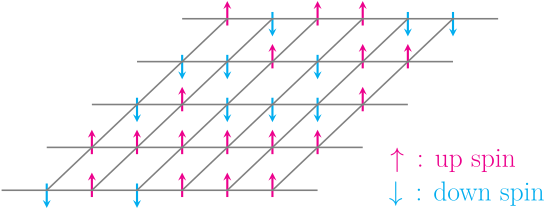
Now imagine a much stranger version of the same trick, played with something simpler than marbles: a row of switches, each one either up or down. Wire pairs of them together, and let each wire carry an opinion: some wires want their two switches to agree, others want them to disagree. Count how many wires get their wish in any given arrangement of the switches. The best arrangement is whichever one keeps the most wires happy.
That switches-and-wires puzzle has a name: Max-Cut, and this site's own operations research track already teaches it as ordinary graph theory. The idea on this page is what happens when you stop treating that puzzle as something to search through, and start treating it as something to build: a real physical network where "settling toward the arrangement with the fewest unhappy wires" is just what the hardware does when you switch it on, the same way marbles roll downhill without being told to.
Three quite different ways to build that network exist today. How they differ: Working: keep going ↓
Fourteen coupled oscillators settling toward one phase — no search, just the hardware relaxing. The “Let it settle” widget below does the same on a real problem graph.
WorkingThree ways to build one
Every design below needs the same two ingredients: something with exactly two stable states (so it can stand in for a switch, or "spin"), and a way to wire pairs of them together so each connection can push its two spins toward agreeing or disagreeing. What differs is the physical substrate.
| Design | The "spin" | How two are coupled | Demonstrated scale |
|---|---|---|---|
| Oscillator Ising machine (OIM) | An oscillator's phase, locked to 0 or π | Resistive/circuit coupling between oscillators | Thousands of nodes on a single chip |
| Coherent Ising machine (CIM) | A light pulse's phase, locked to 0 or π relative to the pump | Optical coupling or measurement-and-feedback | 2,000 nodes (2016); up to 100,000 in later work |
| Probabilistic-bit machine (p-bit) | A bit that fluctuates continuously between 0 and 1 | Each bit's flip probability is set by its neighbours' current values | 1,000,000 p-bits (2026, networked FPGAs) |
Oscillator Ising machines are the direct extension of the previous page's circuit: instead of one nonlinear oscillator isolated and driven, wire many together. Under a technique called subharmonic injection locking, each oscillator's phase settles to one of exactly two values, 0 or π, which is precisely the two-state "spin" the model needs. Wang & Roychowdhury showed that the network's own phase dynamics are governed by a Lyapunov function with the same shape as the Ising energy, so as the circuit settles toward a stable state, it is provably (not just by analogy) descending the optimisation landscape.
Coherent Ising machines play the identical trick with light instead of electricity: pulses circulating in a fibre loop, pumped as degenerate optical parametric oscillators, whose phase also locks to one of two values relative to the pump. Coupling between pulses is engineered optically or via fast measurement-and-feedback. The two landmark demonstrations shipped in the same week of 2016: a 2,000-node machine and, separately, a fully-connected 100-spin machine, two different trade-offs (many weakly-connected nodes versus fewer nodes with every possible connection wired in) that still define the design space today.
Probabilistic bits (p-bits) take a different route entirely: instead of settling to a fixed value, each unit keeps fluctuating between 0 and 1, with the probability of landing on either one set by its neighbours' current states: a direct physical stand-in for a stochastic neural network (a Boltzmann machine). The core primitive was established with stochastic magnetic tunnel junctions, whose natural thermal noise makes the physical flipping happen for free. The 2026 scale record didn't need exotic new materials at all: networking ordinary FPGAs together, exchanging only a single bit of boundary state between chips, reached one million p-bits.
A related idea generalises past pure optimisation entirely: thermodynamic computing treats a circuit's own electrical noise as a computational resource for a wider class of AI primitives (sampling from a distribution, Bayesian inference, the noise-adding step inside a diffusion model) rather than something to fight. A working prototype exists already, and it is built from exactly the component this site started with: eight ordinary RLC circuits, wired all-to-all, running real Gaussian sampling and matrix inversion. Same physics, aimed at a broader job.
Let it settle
Two coupled oscillators only ever do one of two things: lock in phase if their coupling wants them to agree, or lock out of phase if it wants them to disagree.
Below is a small five-node network with seven such couplings wired in, a properly frustrated instance: the five outer edges all want their neighbours to disagree, but you cannot walk around a five-sided loop alternating disagree/disagree/disagree/disagree/disagree and have it come out consistent. Something has to give. Shuffle the starting phases and let the circuit settle, exactly the way the hardware above does it: by integrating the same coupling rule forward in time, nothing more.
A small graph, settling
Toy model: the graph, its couplings, and the true optimum are all computed here, the optimum by brute-force enumeration of all 2⁵ = 32 spin arrangements, run once in your browser. That enumeration also shows every discrete local minimum on this graph is a global optimum — four assignments, which are two arrangements and their mirror images, the count the readout above prints — so a settle that falls short has not found some other valid arrangement and stopped there. The widget implements only half of Wang & Roychowdhury's coupling rule (dθ/dt = −KΣJijsin(θi−θj) alone, by simple Euler steps) and leaves out the injection-locking term that pins a phase toward 0 or π. Without it a settle can land, and stay (stable out to 100,000 steps), at a phase near neither state cleanly, which a crude read-off then rounds to the nearest spin. That is also what real oscillator hardware does when its injection-locking strength is too weak relative to its coupling, which is one reason those machines are annealed rather than trusted on one pass.
The Bench: three methods, many replays
The Bench is the race mode of the Heuristic Arena, where the Annealing Volcano is level one.
One settle, once, proves nothing, the same rule the Annealing Volcano already holds you to, judging a schedule on 500 replays rather than one lucky run. Here are three very different methods (a method with no cleverness at all, the classical annealer, and the oscillator relaxation above) raced on a single larger graph, 200 runs each, at whatever time budget you give them. Move the slider and watch the ranking reshuffle.
Eight nodes, three methods, your budget
Click to run.
Limits: the true optimum is brute-forced over all 2⁸ = 256 arrangements at load, exactly as above. "Time budget" is not a perfectly fair unit across three kinds of machine, since a random-restart attempt, a single-spin-flip Metropolis step, and one Euler step of a continuous relaxation are not the same amount of physical work. And at a high budget on this tiny 256-arrangement graph, blind random restart can catch up to and even pass the annealer, not because randomness is clever but because trying enough independent guesses against a small enough haystack finds the needle by brute coverage. That evaporates the moment a graph is too large to nearly enumerate by luck, which is every real optimisation problem, and exactly why annealing exists at all.
The formalism, with receipts
The Ising Hamiltonian over spins si ∈ {−1, +1} on a graph with couplings Jij is
Finding the ground state (the spin assignment minimising H) is NP-hard in general, and a striking fact does most of the work in this field: an enormous range of NP-hard combinatorial problems, including Max-Cut, graph colouring and satisfiability, can be rewritten exactly in this form, at a cost of at most a cubic blow-up in the number of spins (Lucas, arXiv 1302.5843, Frontiers in Physics 2, 5 (2014), covering all 21 of Karp's original NP-complete problems). This is exactly the QUBO/Ising bridge this site's own operations-research track already names as the doorway every quantum-optimisation claim has to walk through, and the hardware below is what walks through it classically.
Oscillator Ising machines. Under subharmonic injection locking, an oscillator's phase θ is pulled toward 0 or π. Wang & Roychowdhury, arXiv 1903.07163, prove (their Eq. 10) that a network of such oscillators evolves under a Lyapunov function with two parts: E(θ) = −K Σ Jij cos(θi − θj) − Ks Σ cos(2θi): a coupling term, sharing its stationary points with the Ising energy, plus a separate injection-locking term whose entire job is pinning each oscillator toward 0 or π on its own. Both terms are load-bearing: coupling alone has no reason to prefer 0/π over any other pair of opposite phases, and injection-locking alone has no reason to prefer one binary pattern over another. The widget above implements the coupling term only; see its disclosure for what that costs.
Coherent Ising machines. A degenerate optical parametric oscillator, pumped above threshold, bifurcates into one of two possible output phases 0 or π relative to the pump: the same two-state trick, implemented in light. Inagaki et al., Science 354, 603 (2016), coupled 2,000 time-multiplexed pulses in a single fibre loop via measurement-and-feedback; the same week, McMahon et al., Science 354, 614 (2016), built a smaller (100-spin) machine with every pair of spins directly, optically coupled: the two ends of the same trade-off oscillator machines face on a chip, breadth of connection versus number of nodes.
Probabilistic bits. A p-bit's state is a stochastic function of its instantaneous input current, updating so that its time-averaged value follows a sigmoid probability of being +1: the textbook building block of a Boltzmann machine, realised in physical hardware rather than simulated in software. Camsari, Faria, Sutton & Datta, Phys. Rev. X 7, 031014 (2017), established the primitive using stochastic magnetic tunnel junctions. Aadit et al., arXiv 2606.25313 (2026), scaled it to one million p-bits without exotic hardware: ordinary FPGAs networked together, each holding its own local coupling weights and exchanging only single-bit boundary states with its neighbours, a scaling strategy closer to distributed computing than to physics.
Thermodynamic computing. Coles et al., arXiv 2302.06584 (2023), frame a wider class of AI algorithms (generative diffusion models, Bayesian neural networks, Monte Carlo sampling, simulated annealing itself) as sharing a common reliance on stochastic fluctuation, and propose hardware that supplies that fluctuation physically rather than computing pseudorandomness digitally. A working prototype, Melanson et al., arXiv 2312.04836 (2023), built a "stochastic processing unit" from eight all-to-all coupled RLC circuits on a single board (the same component family this site's own circuit page teaches, coupled and left to fluctuate rather than driven and isolated) and demonstrated genuine Gaussian sampling and the first thermodynamic matrix inversion.
None of this settles the question the page opened with. Bernal Neira, Brown, Sathe, Wudarski, Pavone, Rieffel & Venturelli, arXiv 2402.10255 (2024), develop benchmarking and parameter-tuning methodology for exactly this kind of race and run it concretely on a coherent-Ising-machine simulator against parallel tempering (a classical heuristic); quantum annealers motivate the paper's framing but are not the hardware its own worked example races. What it finds: no universal winner even in that one comparison, with optimal parameter choices and which method comes out ahead varying significantly instance by instance. That is the state of the field: not "classical beats quantum" or the reverse, but an open contest whose winner depends on the problem you hand it. The Bench above reproduces this instance-dependence in miniature, on purely classical methods, with the ranking flip shown directly.
A single relaxation pass, as run above, is not how real oscillator or coherent Ising hardware is operated: production coherent Ising machines ramp their pump power gradually from below threshold, which is itself a form of annealing. The Bench picks the harder, colder case, so the oscillator method under-performing there is expected.
References
• Ising formulations of NP-hard problems: Lucas, arXiv 1302.5843 (Frontiers in Physics 2, 5 (2014))
• Oscillator Ising machines: Wang & Roychowdhury, arXiv 1903.07163 (2019)
• Coherent Ising machine, 2,000 nodes: Inagaki, Haribara, Igarashi et al., Science 354, 603 (2016)
• Coherent Ising machine, 100 spins, fully connected: McMahon, Marandi, Haribara et al., Science 354, 614 (2016)
• p-bits, the foundational primitive: Camsari, Faria, Sutton & Datta, Phys. Rev. X 7, 031014 (2017)
• p-bits at scale, 1,000,000 units: Aadit, Zhang, Chowdhury et al., arXiv 2606.25313 (2026)
• Thermodynamic AI, the framework: Coles, Szczepanski, Melanson et al., arXiv 2302.06584 (2023)
• Thermodynamic computing, the hardware: Melanson, Abu Khater, Aifer et al., arXiv 2312.04836 (2023)
• No universal winner, the benchmark: Bernal Neira, Brown, Sathe et al., arXiv 2402.10255 (2024)
Check yourself
A quantum annealer and an oscillator Ising machine are given the exact same Max-Cut problem. What is different between them?
Both machines are built around the identical mathematical target, minimise Σ Jijsisj, which is why they compete head to head rather than being different tools for different jobs. What differs is entirely the physical mechanism that does the minimising. And neither one is exempt from landing on a local rather than global minimum: a well-documented limitation on both sides.
Go deeper
⚡ The circuit underneath
What one of this page's oscillators is, and how a single nonlinear one becomes a qubit instead.
What is a qubit made of? →◆ The full OR track
Max-Cut, the QUBO/Ising bridge, and33 topics that operations research already runs on.
The Feasible Region →🌋 Prove it yourself
The same "does it find the optimum" question, played as a game against a real annealing schedule.
The Annealing Volcano →