A History of Quantum Computing, with Sources

From a calculating trick in 1900 to error rates that fall as machines grow. 22 milestones, each with the paper it comes from.

How to read this

Each entry is one result that something later depends on: a first report of an idea, an experiment that made a piece of the idea real, or a claim that is still argued. It is a selection, and leaving something out is not a judgement on it. The summaries are written for this site; the source line under each is the paper to go to. The 23 papers and proceedings cited from 1901 to 2024 carry DOI links, and the DOIs were looked up on Crossref when they were added.

11 photographs appear, each with its credit and licence, and where a photograph shows a later machine than the one in the entry, the credit says so. The research articles written on this site are listed at the end. The "On SymbiQ" line under an entry links to the lesson here that explains the idea.

Foundations1900 to 1979The idea1980 to 1993Algorithms and error correction1994 to 2000First hardware2001 to 2011Scaling up2012 to 2022The error-correction era2023 to 2026From the desk2026

The map

Seven tracks, one for each line of work, against a time axis that runs from 1900. A dot is a milestone and a link to its entry. The shading alternates by era. It is a selection, so an empty stretch is not a claim that nothing happened.

Foundations

The physics that quantum computing is built from: energy in lumps, entanglement, and a test for it.

1900 to 1901

Energy comes in lumps

Max Planck fitted the measured spectrum of heat radiation by assuming that energy is exchanged in discrete amounts. He at first treated it as a calculating device, not as a claim about nature. The idea of a smallest unit of energy is where the word quantum in quantum computing begins.

People: Max Planck
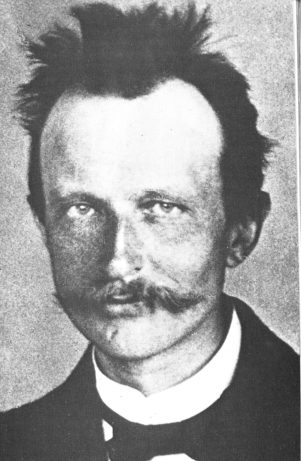
Max Planck, black and white portrait
Unknown photographer, public domain source

Source: M. Planck, "Ueber das Gesetz der Energieverteilung im Normalspectrum", Annalen der Physik 309, 553 (1901) (doi:10.1002/andp.19013090310)

On SymbiQ: Is quantum computing just quantum mechanics?
October 1927

The people who built the theory argue about it

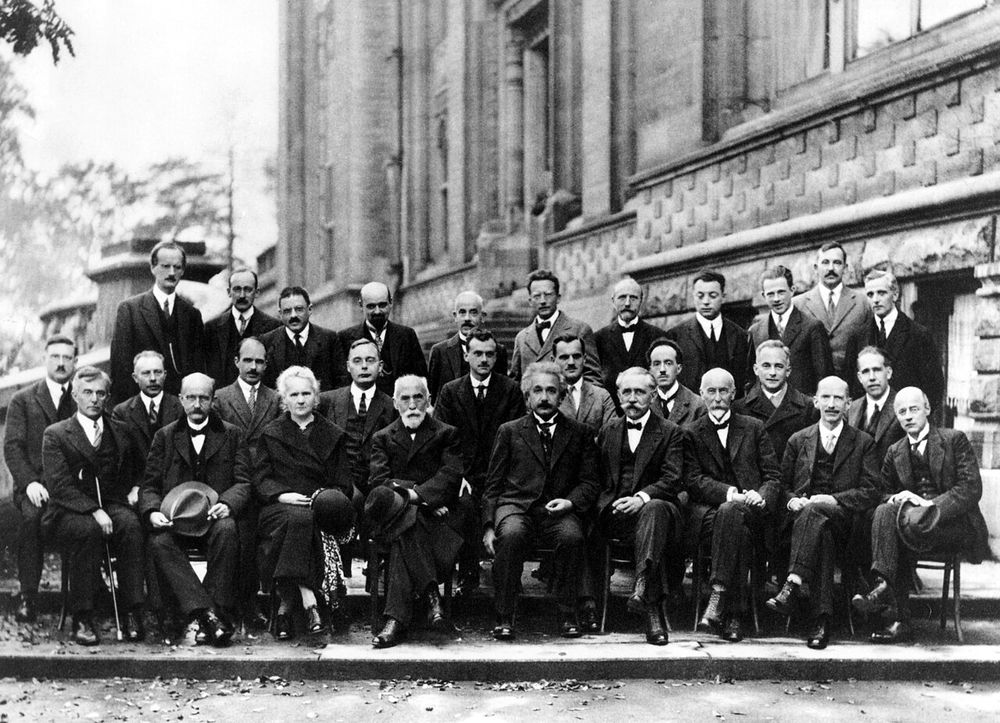
The fifth Solvay Conference in Brussels brought together most of the physicists who had just built quantum mechanics, and the argument about what it means began in earnest there. The photograph is the standard record of who was in the room.

People: Einstein, Bohr, Heisenberg, Schrodinger, Dirac, Pauli, Planck, Born, de Broglie

Black and white group photograph of the 1927 Solvay Conference: about thirty physicists in three rows outside a building
Benjamin Couprie, public domain source

Source: Group photograph by Benjamin Couprie, Institut International de Physique Solvay, 1927 (public domain) (source)

On SymbiQ: Quantum mechanics and quantum computing

1935

Entanglement is named as a problem

Einstein, Podolsky and Rosen described two particles whose measured properties stay correlated however far apart they are, and argued that quantum mechanics must therefore be an incomplete description. They meant it as an objection. The correlation they wrote down is now the working resource of quantum computing.

People: Albert Einstein, Boris Podolsky, Nathan Rosen

Source: A. Einstein, B. Podolsky and N. Rosen, "Can quantum-mechanical description of physical reality be considered complete?", Physical Review 47, 777 (1935) (doi:10.1103/PhysRev.47.777)

On SymbiQ: Play the CHSH game

1964

A way to test it

John Bell showed that any theory in which each particle carries its own hidden instructions must obey a limit on how strongly distant measurements can agree, and that quantum mechanics predicts results beyond that limit. The argument turned a philosophical dispute into an experiment.

People: John S. Bell

Source: J. S. Bell, "On the Einstein Podolsky Rosen paradox", Physics Physique Fizika 1, 195 (1964) (doi:10.1103/PhysicsPhysiqueFizika.1.195)

On SymbiQ: The CHSH game, played

1969

The test, in a form a lab can run

Clauser, Horne, Shimony and Holt rewrote Bell's limit as a single number that real apparatus can measure, with allowance for imperfect detectors. The CHSH form is the one used in the laboratory ever since, and in this site's game.

People: John Clauser, Michael Horne, Abner Shimony, Richard Holt

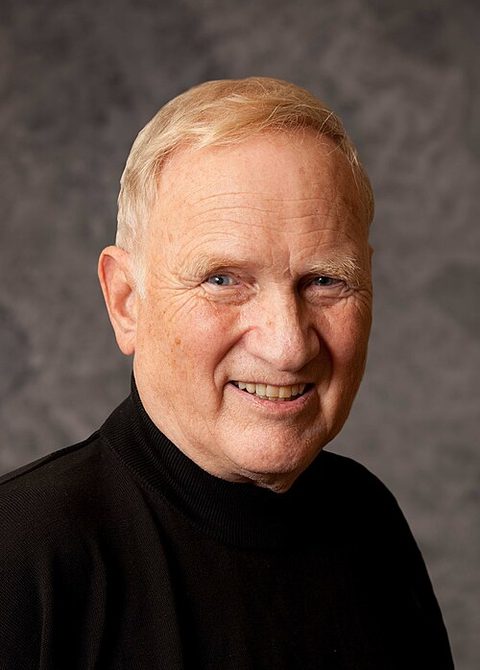
John Clauser, portrait photograph
Peter Lyons, CC BY-SA 4.0 licence source

Source: J. F. Clauser, M. A. Horne, A. Shimony and R. A. Holt, "Proposed experiment to test local hidden-variable theories", Physical Review Letters 23, 880 (1969) (doi:10.1103/PhysRevLett.23.880)

On SymbiQ: The CHSH game

The idea

Someone asks whether a computer could itself be quantum.

1980

A computer that obeys quantum mechanics

Paul Benioff wrote down a quantum-mechanical model of a Turing machine: a computer whose every step is governed by the Schrodinger equation. It showed that computation and quantum mechanics are compatible, which was not obvious.

People: Paul Benioff

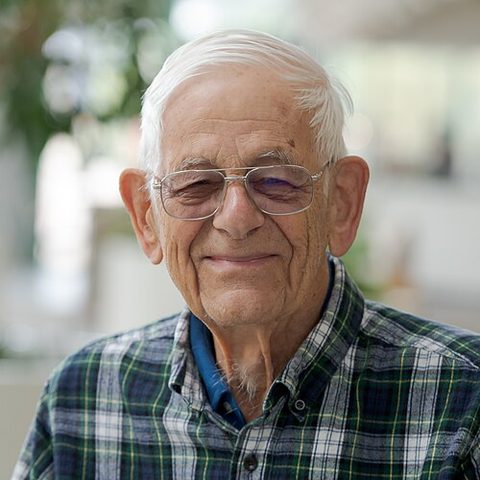
Paul Benioff, portrait photograph with glasses
Justinhsb, CC BY 4.0 licence source

Source: P. Benioff, "The computer as a physical system: A microscopic quantum mechanical Hamiltonian model of computers as represented by Turing machines", Journal of Statistical Physics 22, 563 (1980) (doi:10.1007/BF01011339)

On SymbiQ: What is quantum computing?

1981 talk, 1982 paper

Why not simulate nature with a quantum computer?

Richard Feynman pointed out that an ordinary computer seems to need exponentially more effort to follow a quantum system, and suggested building a computer out of quantum parts instead. Simulating molecules and materials is still among the applications researchers most often expect to arrive first.

People: Richard Feynman

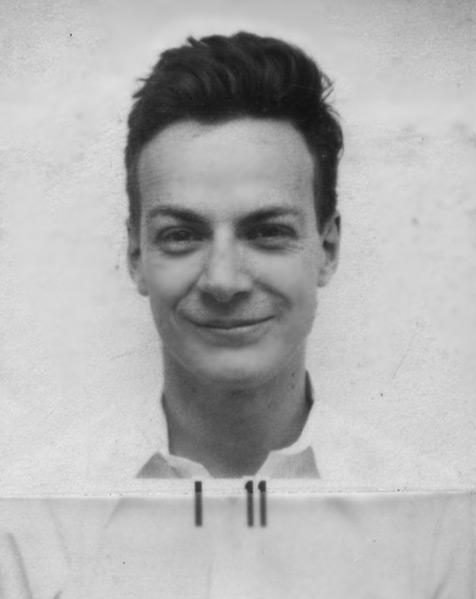
Richard Feynman, Los Alamos identity badge photograph
United States Army, public domain source

Source: R. P. Feynman, "Simulating physics with computers", International Journal of Theoretical Physics 21, 467 (1982) (doi:10.1007/BF02650179)

On SymbiQ: What would you actually use one for?

1985

The universal quantum computer

David Deutsch defined a universal quantum computer, one machine that can imitate any physically possible quantum computation, and proposed a quantum version of the Church-Turing principle. It gave the field its basic object.

People: David Deutsch

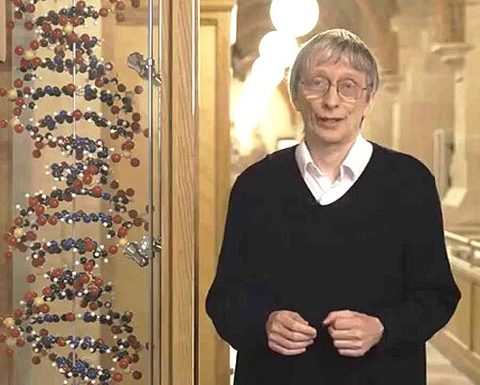
David Deutsch, portrait photograph
Simon Benjamin, CC BY 3.0 licence source

Source: D. Deutsch, "Quantum theory, the Church-Turing principle and the universal quantum computer", Proceedings of the Royal Society A 400, 97 (1985) (doi:10.1098/rspa.1985.0070)

On SymbiQ: The mathematics behind it

Algorithms and error correction

Two reasons to build one, and a proof that errors can be survived.

1994 talk, 1997 journal version

A reason to build one

Peter Shor gave a quantum algorithm that factors large numbers and computes discrete logarithms in time that grows only polynomially with their size. The best known classical methods are far slower. Because public-key cryptography rests on those two problems, it made quantum computers a security matter.

People: Peter Shor

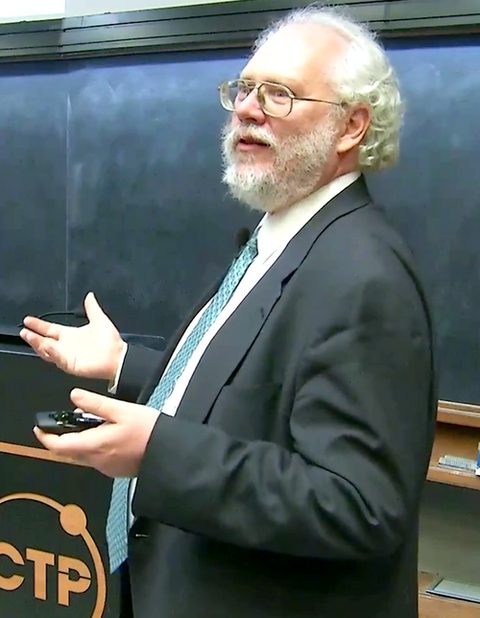
Peter Shor at the 2017 Dirac Medal ceremony
International Centre for Theoretical Physics, CC BY 3.0 licence source

Source: P. W. Shor, "Polynomial-time algorithms for prime factorization and discrete logarithms on a quantum computer", SIAM Journal on Computing 26, 1484 (1997) (doi:10.1137/S0097539795293172)

On SymbiQ: Can quantum computers break Bitcoin? · Post-quantum security

1995

A proposal, then the first logic gate, in trapped ions

Cirac and Zoller proposed a quantum computer made of ions held in a row by electric fields and addressed with lasers. Within months a NIST group led by Wineland demonstrated a controlled-NOT gate between two degrees of freedom of a single trapped beryllium ion, a much-cited early demonstration of a quantum logic gate.

People: Ignacio Cirac, Peter Zoller, Chris Monroe, David Wineland

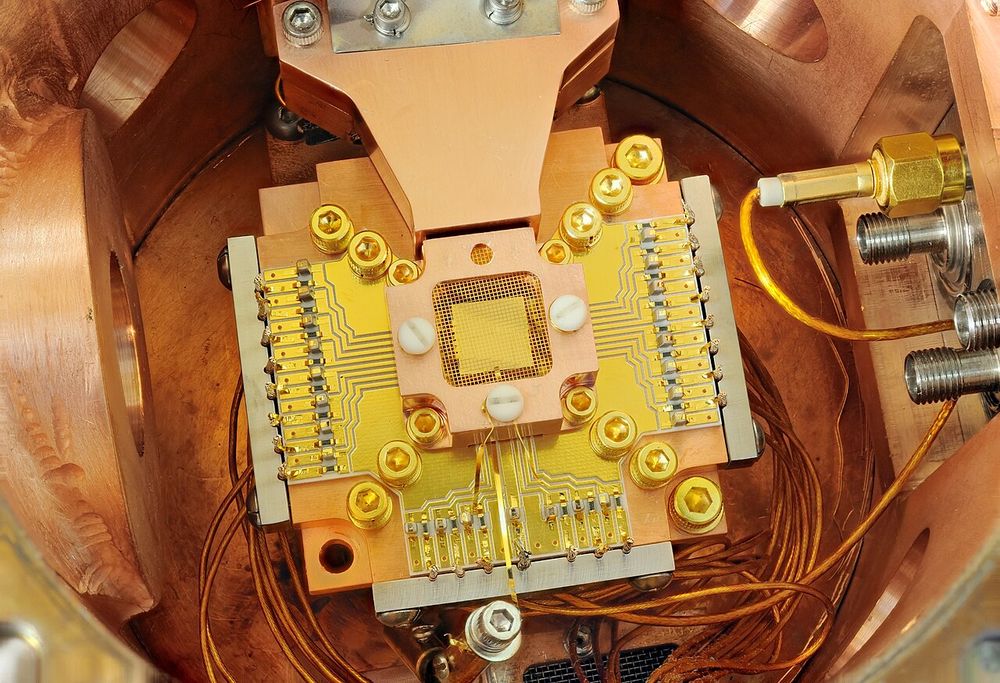
A small gold-patterned chip on a mount in a laboratory, the apparatus used to trap beryllium ions
Y. Colombe/NIST, public domain (a later apparatus, not the 1995 one) source

Source: J. I. Cirac and P. Zoller, "Quantum computations with cold trapped ions", Physical Review Letters 74, 4091 (1995); C. Monroe et al., "Demonstration of a fundamental quantum logic gate", Physical Review Letters 75, 4714 (1995) (doi:10.1103/PhysRevLett.74.4091, doi:10.1103/PhysRevLett.75.4714)

On SymbiQ: Inside a trapped-ion machine · How the technologies compare

1995

Errors can be corrected after all

Quantum states cannot be copied, which seemed to rule out the redundancy that protects ordinary data. Shor showed that one qubit can be spread across nine so that an error on any single one of them can be detected and undone, without measuring the information being protected. Steane's seven-qubit code followed in 1996.

People: Peter Shor, Andrew Steane

Source: P. W. Shor, "Scheme for reducing decoherence in quantum computer memory", Physical Review A 52, R2493 (1995); A. M. Steane, "Error correcting codes in quantum theory", Physical Review Letters 77, 793 (1996) (doi:10.1103/PhysRevA.52.R2493, doi:10.1103/PhysRevLett.77.793)

On SymbiQ: What is quantum error correction?

1996

Searching faster, but only quadratically

Lov Grover gave a quantum algorithm that finds a marked item among N unsorted ones in about the square root of N steps. A later proof showed that no quantum algorithm can do better at this black-box search problem, so the speedup is real and also strictly limited.

People: Lov Grover

Source: L. K. Grover, "A fast quantum mechanical algorithm for database search", Proceedings of the 28th Annual ACM Symposium on Theory of Computing, 212 (1996) (doi:10.1145/237814.237866)

On SymbiQ: Grover's Escape (a game)

1999

A qubit on a chip

Nakamura, Pashkin and Tsai controlled the quantum state of a tiny superconducting island and watched it oscillate coherently. It was the first coherent demonstration of a superconducting qubit, the technology behind many of today's largest machines.

People: Yasunobu Nakamura, Yuri Pashkin, Jaw-Shen Tsai

Source: Y. Nakamura, Yu. A. Pashkin and J. S. Tsai, "Coherent control of macroscopic quantum states in a single-Cooper-pair box", Nature 398, 786 (1999) (doi:10.1038/19718)

On SymbiQ: Inside a superconducting machine · What is a qubit made of?

First hardware

Small machines in several technologies, each showing a piece of the idea.

2001

Factoring fifteen

An IBM and Stanford team used the nuclear spins of a seven-spin molecule, controlled by magnetic resonance, to run Shor's algorithm and factor 15 into 3 and 5. It was a proof of principle on a problem anyone can do in their head, and magnetic-resonance machines of this kind are hard to scale up.

People: Lieven Vandersypen, Isaac Chuang

Source: L. M. K. Vandersypen et al., "Experimental realization of Shor's quantum factoring algorithm using nuclear magnetic resonance", Nature 414, 883 (2001) (doi:10.1038/414883a)

On SymbiQ: How big a machine breaks Bitcoin?

2002

An architecture for many ions

Kielpinski, Monroe and Wineland proposed keeping ions in separate zones of a chip and carrying them between storage and gate zones, a quantum version of a charge-coupled device. Ion machines are still built on this idea.

People: David Kielpinski, Chris Monroe, David Wineland

Source: D. Kielpinski, C. Monroe and D. J. Wineland, "Architecture for a large-scale ion-trap quantum computer", Nature 417, 709 (2002) (doi:10.1038/nature00784)

On SymbiQ: Ion shuttling in 3D · Inside the machine

2007

The transmon

A Yale group redesigned the superconducting qubit so that its frequency barely depends on stray electric charge. The transmon is far less fragile than the earlier designs and is the basis of the qubits on many superconducting chips today.

People: Jens Koch, Robert Schoelkopf

Source: J. Koch et al., "Charge-insensitive qubit design derived from the Cooper pair box", Physical Review A 76, 042319 (2007) (doi:10.1103/PhysRevA.76.042319)

On SymbiQ: Inside the machine: the qubit

2011

Quantum annealing on manufactured spins

D-Wave Systems reported that a small chip of superconducting loops finds low-energy states of an Ising-type problem by quantum annealing, and the company went on to sell larger machines. An annealer solves one shape of problem and is not a general-purpose quantum computer, and whether it ever beats the best classical solvers is still argued over.

People: Mark Johnson, D-Wave Systems

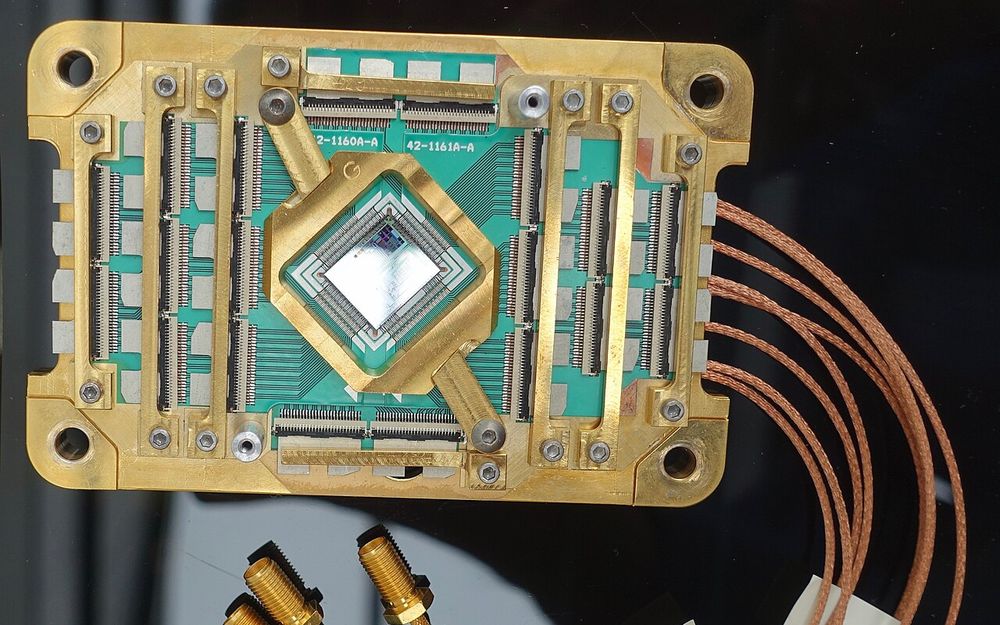
Close-up photograph of a square silicon chip in a ceramic package with gold wiring
Steve Jurvetson, CC BY 2.0 (a later D-Wave Two Vesuvius chip) source

Source: M. W. Johnson et al., "Quantum annealing with manufactured spins", Nature 473, 194 (2011) (doi:10.1038/nature10012)

On SymbiQ: Quantum annealing, explained

Scaling up

Chips with dozens of qubits, a blueprint for error correction, and a contested race.

2012

A blueprint for error correction that fits on a chip

Fowler, Mariantoni, Martinis and Cleland laid out the surface code as a realistic route to large machines: qubits on a flat grid, only nearest neighbours talking, and an error threshold near one percent. Most hardware roadmaps since have been built around it.

People: Austin Fowler, John Martinis

Source: A. G. Fowler, M. Mariantoni, J. M. Martinis and A. N. Cleland, "Surface codes: Towards practical large-scale quantum computation", Physical Review A 86, 032324 (2012) (doi:10.1103/PhysRevA.86.032324)

On SymbiQ: The surface code, interactive · The decoding graph in 3D

2019

A contested claim of quantum advantage

Google reported that its 53-qubit Sycamore chip sampled the outputs of a random circuit in minutes, a task it estimated would take a classical supercomputer thousands of years. Rival groups then showed classical methods could do it far faster than first estimated, and the argument about what the experiment proved has not ended.

People: Frank Arute, John Martinis, Hartmut Neven, Google AI Quantum

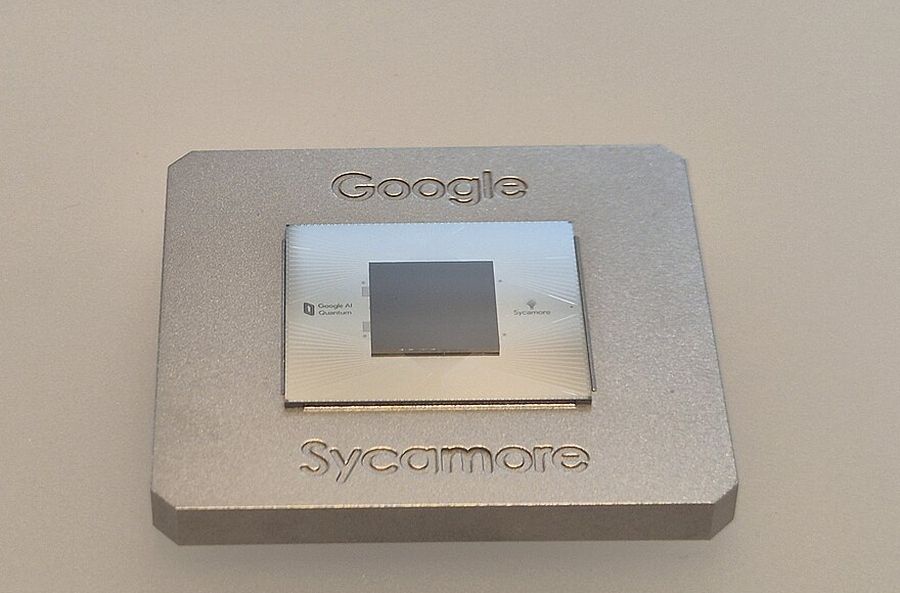
A quantum chip in its metal mount on display in a museum
Coldupnorth, CC BY-SA 4.0 source

Source: F. Arute et al., "Quantum supremacy using a programmable superconducting processor", Nature 574, 505 (2019) (doi:10.1038/s41586-019-1666-5)

On SymbiQ: NISQ and the advantage argument

2020

An advantage claim with light

A team at the University of Science and Technology of China reported a photonic experiment, boson sampling with detected photons, that they said a classical computer could not reproduce in reasonable time. It was a widely cited advantage claim on a photonic platform rather than on superconducting circuits.

People: Han-Sen Zhong, Jian-Wei Pan, Chao-Yang Lu

Source: H.-S. Zhong et al., "Quantum computational advantage using photons", Science 370, 1460 (2020) (doi:10.1126/science.abe8770)

On SymbiQ: The four technologies compared

The error-correction era

The question changes from how many qubits to how good they are.

2023

Logical qubits on neutral atoms

A Harvard, MIT and QuEra collaboration ran small error-detecting and error-correcting codes on arrays of neutral atoms that can be rearranged during the computation, and reported logical qubits that outperformed the physical ones they were built from in some tests.

People: Dolev Bluvstein, Mikhail Lukin

Source: D. Bluvstein et al., "Logical quantum processor based on reconfigurable atom arrays", Nature 626, 58 (2023) (doi:10.1038/s41586-023-06927-3)

On SymbiQ: What is a logical qubit? · The Rydberg blockade in 3D

2024 preprint, 2025 journal

Error rates fall as the code grows

Google Quantum AI measured a surface code on its Willow chip at distances 3, 5 and 7 and found the logical error rate fell by about a factor of two each time the code grew by two, a clear demonstration on a superconducting chip that adding qubits can reduce errors rather than add to them.

People: Google Quantum AI and collaborators

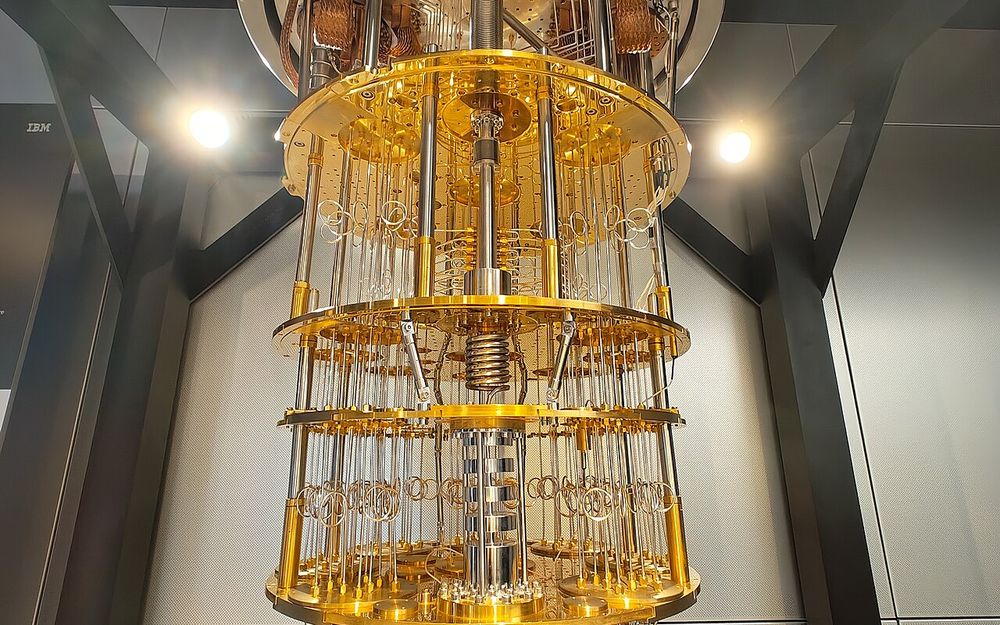
A tall gold-coloured cooling and wiring stack of a quantum computer inside a research building
OJB Quantum (Onri Jay Benally), CC BY 4.0 (an IBM machine, shown for what the inside of a superconducting computer looks like) source

Source: Google Quantum AI and Collaborators, "Quantum error correction below the surface code threshold", Nature 638, 920 (2025) (doi:10.1038/s41586-024-08449-y)

On SymbiQ: The threshold explorer · The race, scored

From the desk: 7 recent results, explained

The research articles on this site cover results from the last few months. Each links to its paper.

All research articles on the home page

Back to the lessons