Sound waves keep a diamond qubit coherent three times longer
A spin qubit in diamond forgets its state when its surroundings drift. Harvard shows that a steady hum of vibration, and nothing else, can stretch its memory about threefold.
A qubit that listens to its surroundings forgets quickly
A qubit is only useful while it remembers a delicate combination of its two states. The fastest way to lose that memory is slow drift in the environment: tiny, gradual changes in magnetic fields and charges around the qubit. The time over which a qubit keeps its phase against this drift is called its dephasing time, written T2*. It is one of the numbers that limits how many operations a qubit can do before it forgets.
The standard remedy is to hit the qubit with carefully timed microwave pulses that cancel the drift. The Harvard paper explains why that is awkward for one important type of machine: quantum networks that carry information as sound. Qubits sitting inside the phononic cavities that trap and route those sound waves do not respond well to that kind of microwave control.
What Harvard did
A team led by Marko Lončar at Harvard’s John A. Paulson School of Engineering and Applied Sciences, with Eliza Cornell and Zhujing Xu as lead experimenters, worked with a silicon-vacancy centre: a defect in diamond where a silicon atom sits next to an empty site. It holds a spin that acts as a qubit. They protected it with sound alone. The paper is All-mechanical coherence protection and fast control of a spin qubit, in Nature Physics 22, 1493 to 1497 (2026), and on arXiv as 2508.13356.
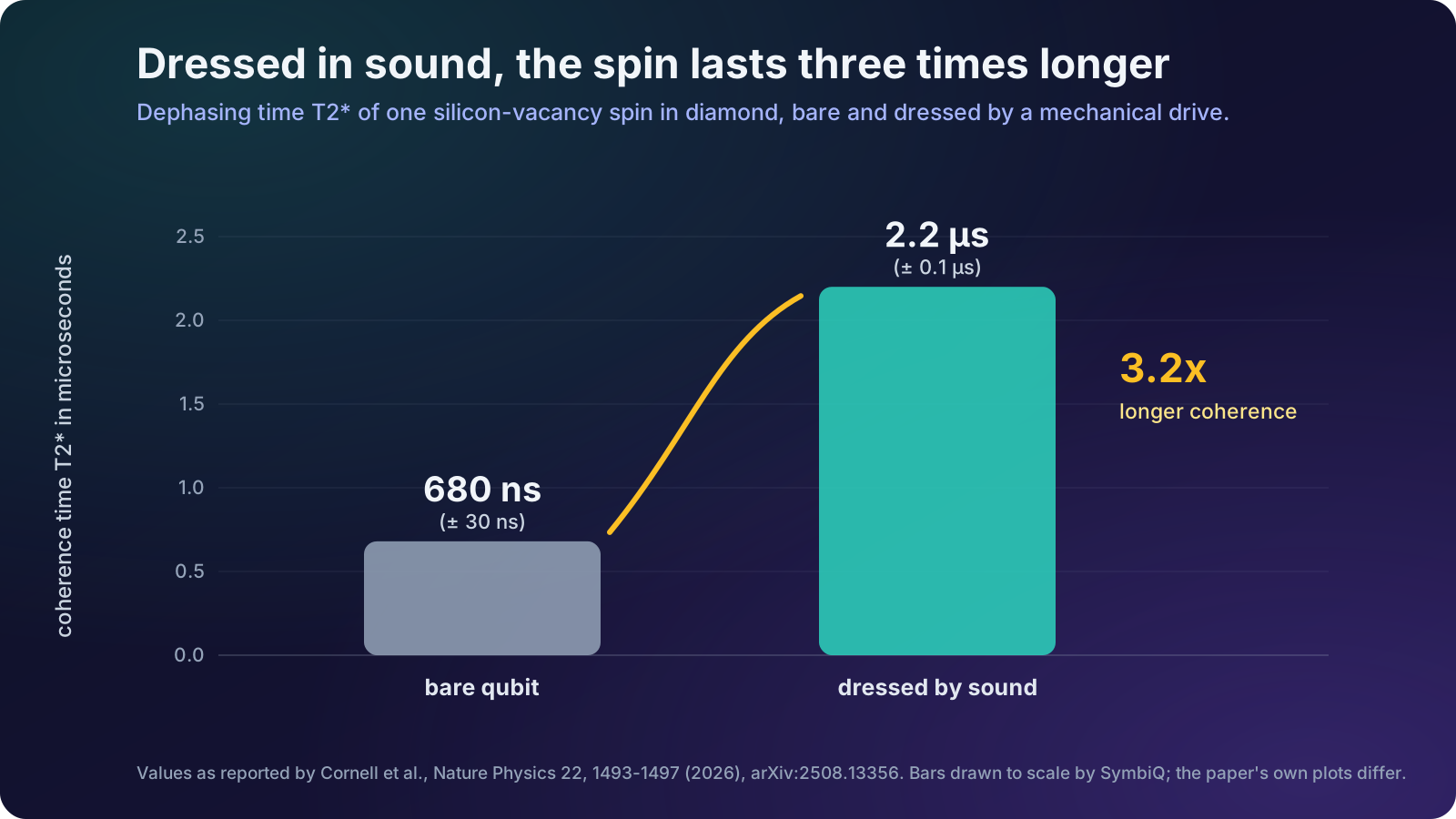
The idea is to apply a continuous mechanical drive, a steady hum of vibration at the right frequency, which turns the qubit into a “dressed” qubit that wears the acoustic field. Harvard’s release reports that its dephasing time rises from 680 ± 30 nanoseconds to 2.2 ± 0.1 microseconds, a gain of about 3.2 times. The abstract also reports Rabi frequencies, a measure of how fast the qubit can be driven, reaching 800 megahertz, which it describes as record-high and ultrafast. Initialisation, operations and readout are all done in the dressed basis.
What the figure shows
The bars at the top are drawn by us to scale from the two numbers above. The grey bar is the bare qubit, the teal bar the dressed one. We drew the comparison and nothing else from the paper, so look to the paper for the underlying plots.
In plain words
Think of trying to read a clock on a boat that keeps lurching. If you stand still the lurching ruins the reading. If you walk in step with the boat, the lurching hardly matters, and what you read depends on the steady rhythm you are keeping. Dressing is similar. Once the qubit is locked to a steady sound drive that we control, its useful energy gap is set mostly by that drive, which we set, and the slow drift from the environment matters much less. To a first approximation the slow noise is averaged away.
What is special is that the protection and the control both come from sound, so nothing has to be added that the phononic cavity would reject. That is the point of the paper’s title.
What this does not show
- 2.2 microseconds is still short. It is a clear improvement and not a long memory. The speed helps: at 800 megahertz one drive cycle lasts about a nanosecond, so on the order of a thousand fit inside 2.2 microseconds. That arithmetic is ours, not a result of the paper.
- It is one qubit. The paper establishes a basis for high-fidelity gates mediated by phonons, in its own words. Those gates, and a network of nodes, are future work.
- The gain is against this kind of noise. Dressing protects against slow, low-frequency drift. It is not protection from every error, and it is not error correction.
Why a reader of this site should care
Qubits that live in light are easy to move and hard to store. Qubits that live in matter are the reverse. A quantum network needs both, and sound is a candidate bridge. This paper removes one obstacle to that picture: how to keep a spin coherent while it sits in a sound-trapping cavity, without bringing in a control method the cavity does not like. For the other sound paper on this desk, which counts the lumps in a vibration, see quantum jumps of sound.
Sources
- Cornell et al., "All-mechanical coherence protection and fast control of a spin qubit", Nature Physics 22, 1493-1497 (2026)
- arXiv preprint 2508.13356
- Harvard SEAS, "Qubits dressed for success"
We read the sources above ourselves. Where a figure or number is ours, the article says so. If you find a mistake, tell us: a wrong sentence here gets logged like any other.
More from the research desk
- Watching a single phonon jump: the first quantum jumps of sound Stanford University
- Braiding and fusing anyons gives a full gate set on 54 qubits UChicago, Harvard, Stony Brook and Quantinuum
- Bosonic-code gates in one driving period instead of thousands Chalmers University of Technology
- A flip at the right moment can stop entanglement from dying Raman Research Institute
- Entanglement over 10 km of fibre that lasts longer than it takes to make University of Science and Technology of China
- Splitting one error-corrected qubit into two entangled ones ETH Zurich
- Every paper on the desk