A flip at the right moment can stop entanglement from dying
Entanglement can vanish at a finite time, long before the particles finish decaying. A team at the Raman Research Institute showed that the timing of a single bit-flip decides whether it dies sooner, later, or not at all.
Entanglement can die suddenly
Two entangled particles lose their link when the world leaks into them. You might expect that to be gradual: the entanglement fades the way the particles lose energy, a little at a time, forever. Often it does not. In many cases the entanglement reaches exactly zero at a finite moment, while the particles are still only part way to their final state. Physicists call it entanglement sudden death. It was seen in the lab in 2007 and reviewed in 2009.
For a quantum computer this matters because entanglement is the thing being spent. If it can switch off early, anything that relies on it has a deadline earlier than the hardware's own decay time suggests.
The idea: act once, and choose when
A team led from the Raman Research Institute in Bengaluru, with collaborators at the University of Calgary and Louisiana State University, asked a narrow question. Suppose the only thing you can do is apply one flip, once, partway through the decay. Does the moment you choose matter?
It matters a great deal. The flip swaps the two energy levels of each particle, so the part of the state that was most likely to decay is now the part that is stable, and the reverse. Applied very early, it leaves the entanglement able to outlast the decay. Applied at an intermediate moment, it postpones the sudden death. Applied late, it makes things worse and the entanglement dies sooner than if you had done nothing. In group leader Urbasi Sinha's words, timing is not just an experimental detail; it can be a control resource
.
The paper's abstract states the result as a framework: the timing of a single local operation can deterministically steer how entanglement decays, to avoid sudden death, delay it, or hasten it.
What the figure shows
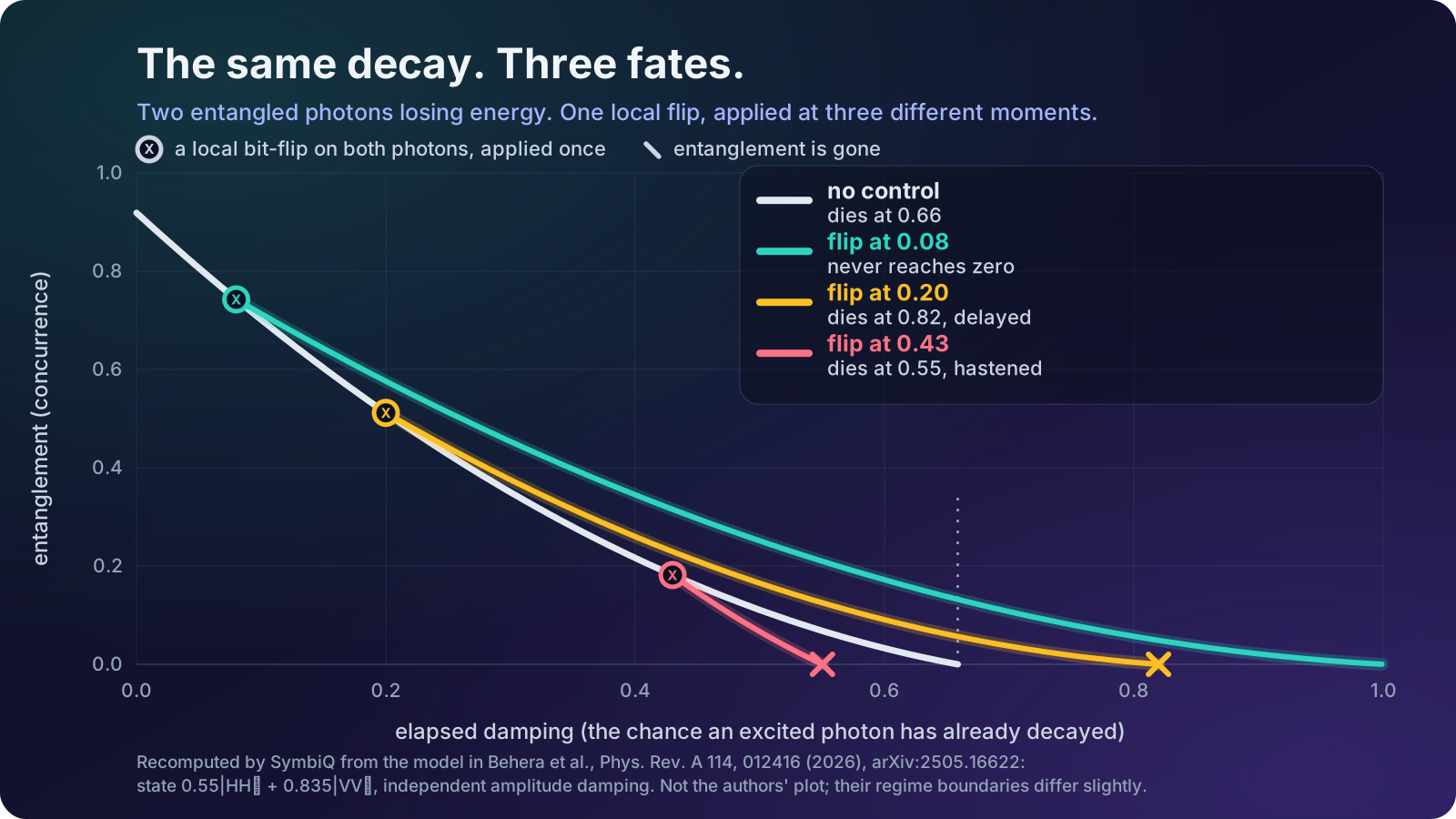
The figure at the top is ours, not the authors'. We took the model in the paper (two photons in the state 0.55|HH⟩ + 0.835|VV⟩, each losing energy independently through an amplitude-damping channel) and simulated it, then plotted the standard measure of entanglement, the concurrence. The horizontal axis is how much damping has happened: the chance that an excited photon has already decayed.
- No control (white): the entanglement reaches zero at 0.66.
- Flip at 0.08 (teal): it never reaches zero. It still fades, but it is never gone.
- Flip at 0.20 (amber): sudden death still happens, but later, at 0.82.
- Flip at 0.43 (rose): it dies sooner, at 0.55.
Our simulation puts the boundary between “avoided” and “delayed” near 0.14 and the boundary between “delayed” and “hastened” near 0.28. The paper quotes slightly different numbers for the first boundary, which depends on the exact model and state, so treat our figure as an illustration of the three behaviours and the paper as the authority on where the lines sit.
How they tested it
The experiment used pairs of photons entangled in polarisation: horizontal for the ground state, vertical for the excited one. Waveplates acted on the polarisation to imitate the loss of energy, and a waveplate at the right angle did the flip. The entanglement was then measured by quantum state tomography. Light is convenient here because the amount of damping can be set exactly. Each setting gave the entanglement a different decay, and the paper reports that all three behaviours the theory predicts appeared.
What this does not show
- The photons are not decaying atoms. The loss of energy is imitated by optics. That is a faithful test of the mathematics, and not yet a test on a qubit in a cryostat.
- You have to know the clock. The benefit depends on knowing how far the decay has progressed when you flip. Flip at the wrong moment and you make it worse.
- It is one state and one kind of noise. The result is for this family of states under amplitude damping. It is a control idea, not a general shield.
- It is not error correction. Nothing is measured or repaired. One operation, chosen well, changes the fate of the entanglement. Real machines will still need error correction for everything else.
This idea has a history
The 2008 paper by Rau, Ali and Alber showed in theory that local operations during the decay can hasten, delay or avert sudden death. A. R. P. Rau is also an author of the 2026 paper, so this is a prediction made eighteen years earlier meeting a lab. What is new is the single-shot version and its experimental demonstration.
A related paper from May 2026, Liu, Tian and Wang, reports a different surprise in the same setting: that a more strongly entangled initial state can collapse faster than a weaker one, an analogue of the classical Mpemba effect. We have not checked its calculations, so we point to it and no further.
Why a reader of this site should care
This site keeps returning to one idea: the gap between a qubit that works for a moment and a machine that works for hours is closed by control, not luck. Here is a clean example of control in its smallest form. The entanglement is not protected by a bigger code or a colder fridge. It is protected by deciding when to touch it.
Sources
- Behera et al., "Temporal steering of entanglement decay with single-shot control", Phys. Rev. A 114, 012416 (2026), arXiv:2505.16622
- Raman Research Institute, "Scientists uncover a way to outsmart quantum entanglement loss with a single move"
- Rau, Ali and Alber, "Hastening, delaying, or averting sudden death of quantum entanglement", EPL 82, 40002 (2008), arXiv:0711.0317
- Almeida et al., "Environment-induced sudden death of entanglement", Science 316, 579 (2007)
- Yu and Eberly, "Sudden death of entanglement", Science 323, 598 (2009)
- Liu, Tian and Wang, "Stronger entanglement dies faster: quantum Mpemba effect in dissipative qubits", arXiv:2605.23197 (2026)
We read the sources above ourselves. Where a figure or number is ours, the article says so. If you find a mistake, tell us: a wrong sentence here gets logged like any other.
More from the research desk
- Watching a single phonon jump: the first quantum jumps of sound Stanford University
- Sound waves keep a diamond qubit coherent three times longer Harvard SEAS
- Braiding and fusing anyons gives a full gate set on 54 qubits UChicago, Harvard, Stony Brook and Quantinuum
- Bosonic-code gates in one driving period instead of thousands Chalmers University of Technology
- Entanglement over 10 km of fibre that lasts longer than it takes to make University of Science and Technology of China
- Splitting one error-corrected qubit into two entangled ones ETH Zurich
- Every paper on the desk