Watching a single phonon jump: the first quantum jumps of sound
Sound in a tiny resonator comes in lumps called phonons. Stanford has watched one lump vanish in a single step, in real time, using a superconducting qubit as the detector.
Sound comes in lumps, but nobody had watched one
A guitar string fades smoothly. Push it and the sound dies away a little at a time. Quantum mechanics says that at the smallest scale this is only an average. A vibration carries energy in whole packets called phonons, the way light comes in photons. A tiny vibrating object holding exactly one phonon should not fade. It should keep that one packet until, at some random moment, the packet is gone and the object has none. That sudden change is called a quantum jump.
Jumps had been watched for a single trapped ion in 1986 and for light in 2007. The Stanford team reports the same thing for a vibration: individual phonons making jumps, seen in real time. They say it is the first time this has been done for sound.
What Stanford did
A team led by Amir Safavi-Naeini at Stanford, with Takuma Makihara and Erik Szakiel as co-first authors, built a microscopic mechanical resonator, a small vibrating structure made with chip-making methods. They paired it with a superconducting qubit that acts as the detector. The paper, Quantum jumps of sound, is in Science (17 September 2026).
The qubit is coupled to the resonator in a particular way, called dispersive coupling: the qubit’s own frequency shifts by a known amount for each phonon present. The abstract reports a shift of 328 kilohertz per phonon. So the experimenters can ask the qubit “is there a phonon?” by probing its frequency, without absorbing the phonon in the process. In the paper’s terms, this is a repeated quantum non-demolition measurement of the phonon number.
Two other numbers make the experiment possible, both from the abstract. The resonator rings for about 2.1 milliseconds, very long for a device this small. And the team could prepare single-phonon states with 85% fidelity, meaning a heralded phonon was really there about 85% of the time.
What the figure shows
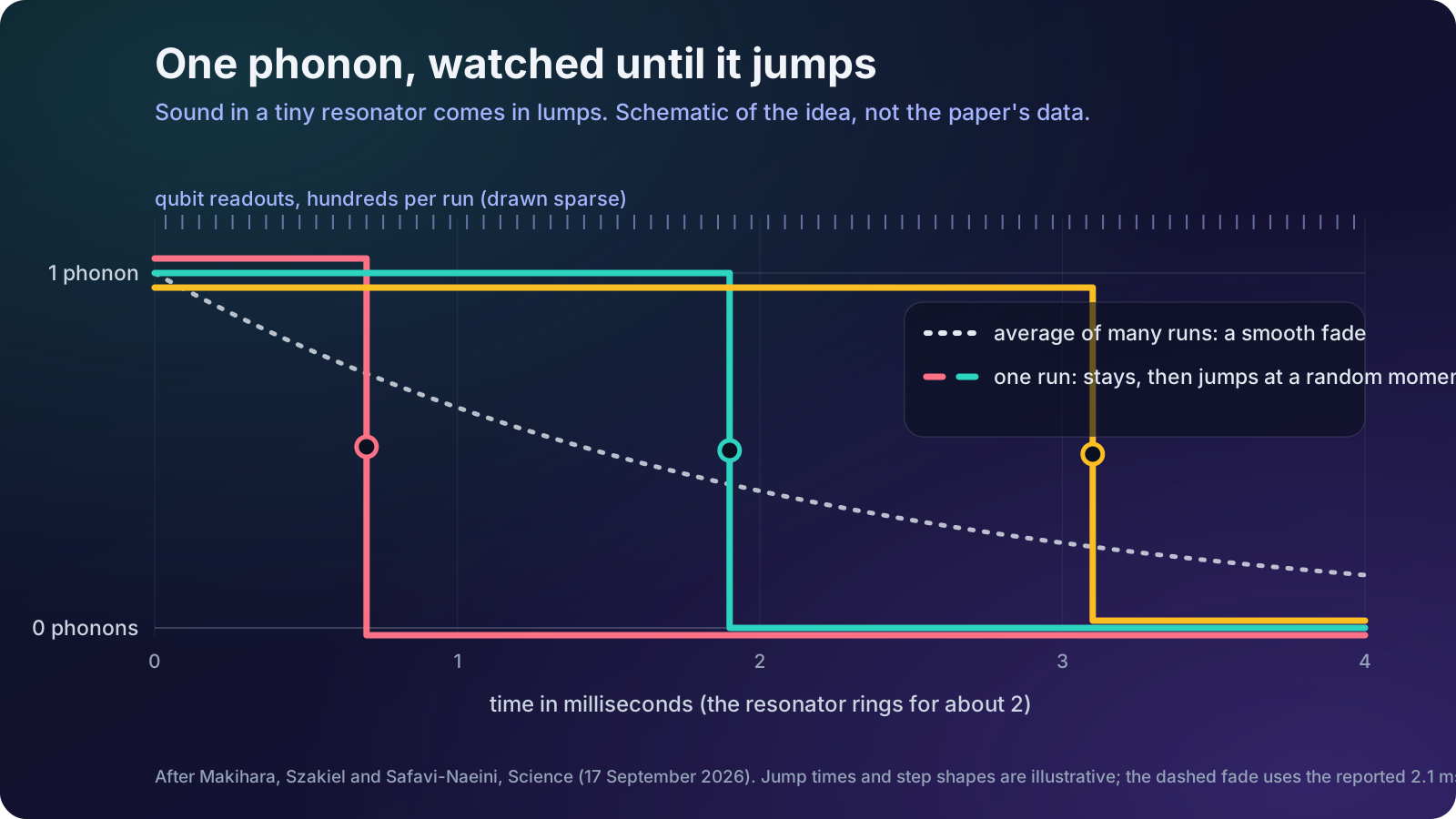
The figure at the top is a drawing of the idea, not the paper’s data. The dashed curve is the average fade of many runs, the smooth decay you would see if you only had the average, with the reported 2.1 millisecond lifetime. The three coloured traces are what single runs look like: the phonon number stays at one, then drops to zero in a single step, at a different random moment each time.
The row of ticks across the top stands for the qubit asking its question again and again. With a lifetime of two milliseconds, Stanford reports that hundreds of readings fit inside one run. That is what lets them pin down when a jump happened, instead of only noticing afterwards that it had.
In plain words
Imagine a light bulb that you can only check by looking at it quickly, many times. A bulb that slowly dims would look a little dimmer each time. A bulb that is either on or off would look exactly the same, until the one look where it is suddenly off. The jump is the moment of that look. The remarkable thing is that the object being watched is a vibrating piece of material made of many atoms, not a single atom or a particle of light.
Quantum mechanics says that if you repeat the run many times and add up the jump moments, they should trace out the smooth fade you would have expected, so the lumpy picture and the smooth one are the same physics seen two ways. What is new is that you can now see the lumps behind the average.
What this does not show
- It is one phonon, not a stream of them. The jump seen is between one phonon and none. Reaching higher phonon numbers is listed by the team as future work.
- The measurement is not perfect. Safavi-Naeini describes it as
very good but not perfectly non-destructive
. The qubit’s own probing can disturb what it is watching, and the team wants to reduce that. - Heralding is 85%, not 100%. The single-phonon states are prepared with a reported fidelity of 85%, so a run does not always start from the clean state you intended.
- The uses are hopes. The team points to error correction, to sensing and to better acoustic devices. A collaboration with Michael Roukes at Caltech asks whether this kind of device could one day help detect proteins. Nothing of the sort has been shown.
- It is a laboratory device. Superconducting qubits are normally run at millikelvin temperatures in a dilution refrigerator, which is a long way from a consumer gadget.
Why a reader of this site should care
This is the first of two papers here about sound as a quantum object. Light has been the usual messenger in quantum machines. Vibrations are slower and shorter-ranged, which makes them good for storing and routing quantum information on a chip. You cannot use that well until you can count the lumps and see them change. The Harvard paper in this desk shows the other side, using sound to protect a qubit. For the machine this site keeps returning to, see what is inside it.
Sources
- Makihara, Szakiel and Safavi-Naeini, "Quantum jumps of sound", Science (17 September 2026), doi:10.1126/science.aeh7535
- Phys.org, "Real-time quantum jump in sound observed for first time"
- ScienceDaily, "For the first time, scientists watch sound jump between quantum states"
- Discover, "Scientists catch sound making a quantum jump with a microscopic tuning fork"
We read the sources above ourselves. Where a figure or number is ours, the article says so. If you find a mistake, tell us: a wrong sentence here gets logged like any other.
More from the research desk
- Sound waves keep a diamond qubit coherent three times longer Harvard SEAS
- Braiding and fusing anyons gives a full gate set on 54 qubits UChicago, Harvard, Stony Brook and Quantinuum
- Bosonic-code gates in one driving period instead of thousands Chalmers University of Technology
- A flip at the right moment can stop entanglement from dying Raman Research Institute
- Entanglement over 10 km of fibre that lasts longer than it takes to make University of Science and Technology of China
- Splitting one error-corrected qubit into two entangled ones ETH Zurich
- Every paper on the desk