Entanglement over 10 km of fibre that lasts longer than it takes to make
A quantum network only works if a link survives the time it takes to build one. Two trapped-ion memories, ten kilometres of fibre apart, now cross that line.
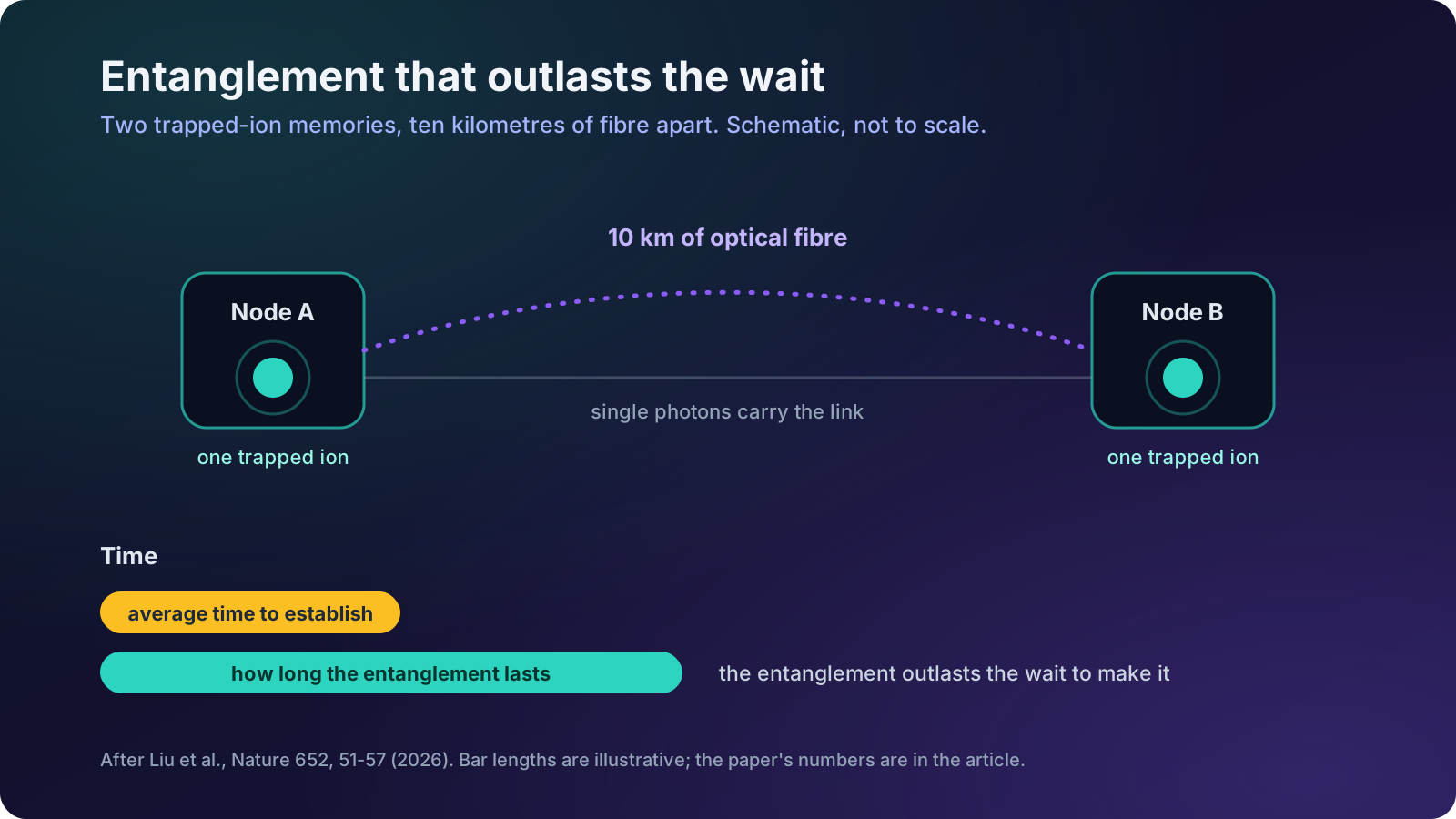
A race between making a link and losing it
A quantum network does not send entanglement down a wire the way an ordinary network sends a signal. It has to make entanglement between two distant memories, and making it is probabilistic: most attempts fail, because the photons that carry the link are lost in the fibre. So the first link takes a while. If the entanglement is lost faster than it is made, the network never gets going. That is the wall quantum repeaters have been trying to climb.
What the team reported
A group at the University of Science and Technology of China, with Wen-Zhao Liu, Ya-Bin Zhou, Jiu-Peng Chen and colleagues, reports entanglement between two trapped-ion memory nodes, joined by 10 km of fibre, that lasts longer than the average time it takes to establish it. In the paper's own words, the entanglement persists beyond the average entanglement establishment time. That is the break-even point: past that point, a link can be made faster than it is lost, which is the minimum a repeater chain needs.
The paper was published in Nature 652, pages 51 to 57 (online 2 February 2026, April 2026 issue). It credits three ingredients: an ion memory that holds its state for a long time, an efficient ion-to-photon interface at telecom wavelengths, and an optimised single-photon entanglement protocol. A secondary summary of the abstract gives the entanglement lifetime as about half a second; we have not seen a primary statement of the exact figure, so we say “about half a second” and no more.
A key-distribution demonstration on top
As a use of the link, the authors report a proof-of-principle device-independent quantum key distribution run. Two numbers are worth reading carefully. Over 10 km it is a result with a finite-size analysis, so it is a statement about a run that actually happened. Over 101 km the positive key rate is an asymptotic figure: what the same setup would give with unlimited data. That is a calculation, not a measurement at 101 km. The paper says both distances exceed earlier device-independent work by more than two orders of magnitude.
If the key-distribution part is new to you, our page on the limits of quantum key distribution explains why several national agencies still prefer post-quantum cryptography.
What this does not show
- Two nodes, one link. A network has many. This is a building block.
- Spooled fibre, not a city. The 10 km is fibre on a spool in a lab, which removes weather, vibration and temperature drift that a buried cable would add.
- Break-even is not fast. The entanglement outlasting its own creation time means the link is usable. It does not say the link is fast, or that you can chain many of them yet.
- One group, one paper. A single result is a result. It becomes a technology when someone else repeats it.
Why it belongs next to the other entanglement story
The Raman Research Institute paper is about entanglement dying early, and what one well-timed operation can do about it. This one is the same worry at network scale: entanglement against a clock. In both, the number that decides whether the idea works is a time, not a count of qubits.
Sources
- Liu et al., "Long-lived remote ion-ion entanglement for scalable quantum repeaters", Nature 652, 51-57 (2026), doi:10.1038/s41586-026-10177-4
- Record in RePEc (volume, issue, pages, DOI)
- Wehner, Elkouss and Hanson, "Quantum internet: a vision for the road ahead", Science 362, eaam9288 (2018)
We read the sources above ourselves. Where a figure or number is ours, the article says so. If you find a mistake, tell us: a wrong sentence here gets logged like any other.
More from the research desk
- Watching a single phonon jump: the first quantum jumps of sound Stanford University
- Sound waves keep a diamond qubit coherent three times longer Harvard SEAS
- Braiding and fusing anyons gives a full gate set on 54 qubits UChicago, Harvard, Stony Brook and Quantinuum
- Bosonic-code gates in one driving period instead of thousands Chalmers University of Technology
- A flip at the right moment can stop entanglement from dying Raman Research Institute
- Splitting one error-corrected qubit into two entangled ones ETH Zurich
- Every paper on the desk