Bosonic-code gates in one driving period instead of thousands
Bosonic codes protect a qubit inside one oscillator, but preparing and controlling them has taken thousands of drive periods. A Chalmers proposal does it in one, so far in simulation.
Another way to build a protected qubit: use a whole oscillator
Most error correction spreads one logical qubit across many physical qubits. Bosonic codes take another route: they store the information in the many possible states of a single oscillator, for example a microwave field in a superconducting cavity. The code is chosen so that the most common errors, such as losing one photon, push the state to a place where it can be recognised and put back. Cat codes, binomial codes and GKP codes are three examples.
The catch is control. To prepare these states and to run gates on them, experiments have used periodic drives with slow, gentle ramps that take thousands of driving periods. That matters because, as Lei Du puts it, the longer an operation takes, the greater the risk that disturbances corrupt the information before it is done.
What the paper reports
Tangyou Huang and Lei Du at Chalmers University of Technology, with Lingzhen Guo of Tianjin University, describe a way to do the same job in a single driving period. They call the building blocks quantum lattice gates, and the method Floquet control (control by a periodic signal). Chalmers describes them as prebuilt modules instead of laying the structure brick by brick. The paper, Single-Period Floquet Control of Bosonic Codes with Quantum Lattice Gates, is in Physical Review Letters 137 (2026), and on arXiv as 2601.08782.
In simulation, the authors prepare binomial, cat and GKP code states from the vacuum, and perform the elementary logical gates H, S and T on them. The preprint reports gate errors at or below about 10−4 and state-preparation infidelities below 10−5. It describes the result as more than three orders of magnitude faster than existing adiabatic protocols, which is the “more than 1,000 times faster” in the headlines.
What the figure shows
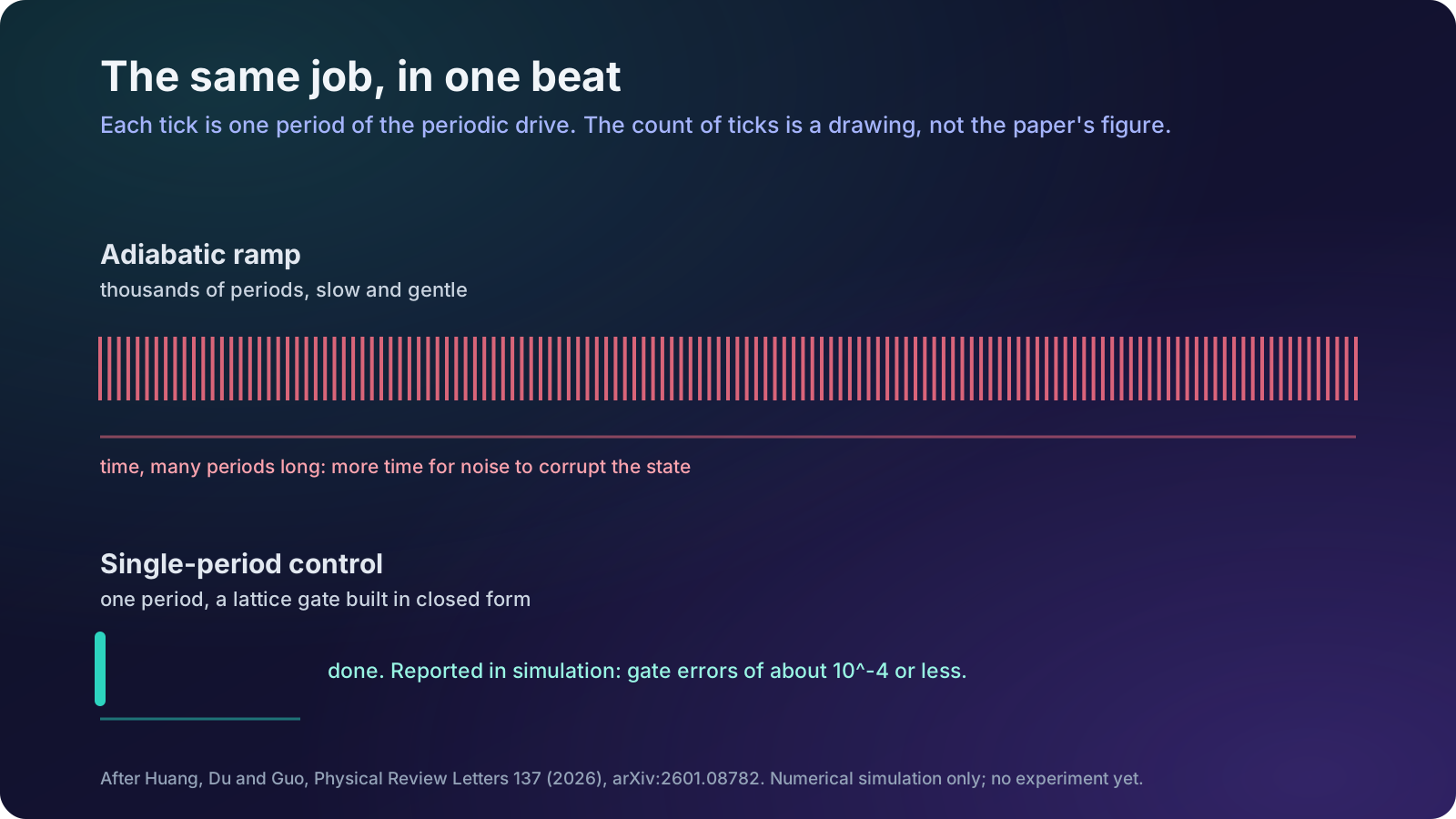
The figure at the top is a drawing. Each tick is one period of the drive. The older method fills a long timeline with them, the new one needs one. The number of ticks on the top row is only for illustration. What is faithful to the paper is the contrast, thousands of periods against one, and the simulated error level written beside the single tick.
In plain words
To guide a marble to a spot on a table you can tilt the table slowly and let it roll, a slow ramp. Or you can compute exactly how to flick it once. The first is gentle and reliable and takes a long time. The second is quick, and needs a good calculation. This paper provides the calculation for a particular kind of system, and shows by simulation that the flick lands where it should.
What this does not show
- It is simulation, not an experiment. The authors say they are discussing experimental realisations with colleagues, and hope to see a demonstration. No device has run it yet.
- “1,000 times faster” counts driving periods. It compares how many periods are needed, not a stopwatch measurement of a real gate.
- The model is idealised. The simulation assumes an ideal Josephson nonlinearity, a finite cutoff of photon number, and does not put hardware limits into the main results. The paper points to a separate reference for how control errors and decoherence affect it.
- It is not a full machine. Gates on one encoded oscillator are a necessary part of a computer and a small one. Connecting many, measuring them and correcting errors between them remains.
Why a reader of this site should care
This is the kind of paper that moves a number that matters without a new device: the time during which a protected qubit is exposed to noise. If the simulation survives contact with hardware, it would shorten one of the most time-consuming steps for bosonic-code machines. It is the reverse case to the sound papers on this desk: a promise made by mathematics, awaiting an experiment. Compare it with the lattice-surgery experiment, which is an experiment, with a smaller claim.
Sources
- Huang, Du and Guo, "Single-Period Floquet Control of Bosonic Codes with Quantum Lattice Gates", Physical Review Letters 137 (2026), doi:10.1103/tnb8-3m8m
- arXiv preprint 2601.08782
- Phys.org, "1,000 times faster operations bring reliable quantum computing a step closer"
- The Quantum Insider, "Chalmers researchers make bosonic quantum operations more than 1,000 times faster"
We read the sources above ourselves. Where a figure or number is ours, the article says so. If you find a mistake, tell us: a wrong sentence here gets logged like any other.
More from the research desk
- Watching a single phonon jump: the first quantum jumps of sound Stanford University
- Sound waves keep a diamond qubit coherent three times longer Harvard SEAS
- Braiding and fusing anyons gives a full gate set on 54 qubits UChicago, Harvard, Stony Brook and Quantinuum
- A flip at the right moment can stop entanglement from dying Raman Research Institute
- Entanglement over 10 km of fibre that lasts longer than it takes to make University of Science and Technology of China
- Splitting one error-corrected qubit into two entangled ones ETH Zurich
- Every paper on the desk