Logical errors cut up to 800 times on trapped ions, with a catch
Two small error-correcting codes on a trapped-ion chip beat the bare qubits they are built from. The best numbers depend on discarding runs that flag an error.
Error correction has to beat the thing it protects
Every quantum computer makes mistakes. Error correction spreads one piece of information across several physical qubits so that a mistake in one can be spotted and repaired. There is a catch that people sometimes skip: the scheme itself is built from noisy operations. If the machinery adds more errors than it removes, the “protected” qubit is worse than a bare one. The test that matters is simple. Run the same small circuit twice, once on bare qubits and once encoded, and see which gives fewer wrong answers.
What Microsoft and Quantinuum report
A team from Microsoft Quantum and Quantinuum ran that test on a trapped-ion processor built on Quantinuum’s “QCCD” design, in which ions are shuttled between zones. The paper, Improved quantum processor logical error rates via correction and detection, is in Nature (volume 654, pages 349 to 355, published online 10 June 2026).
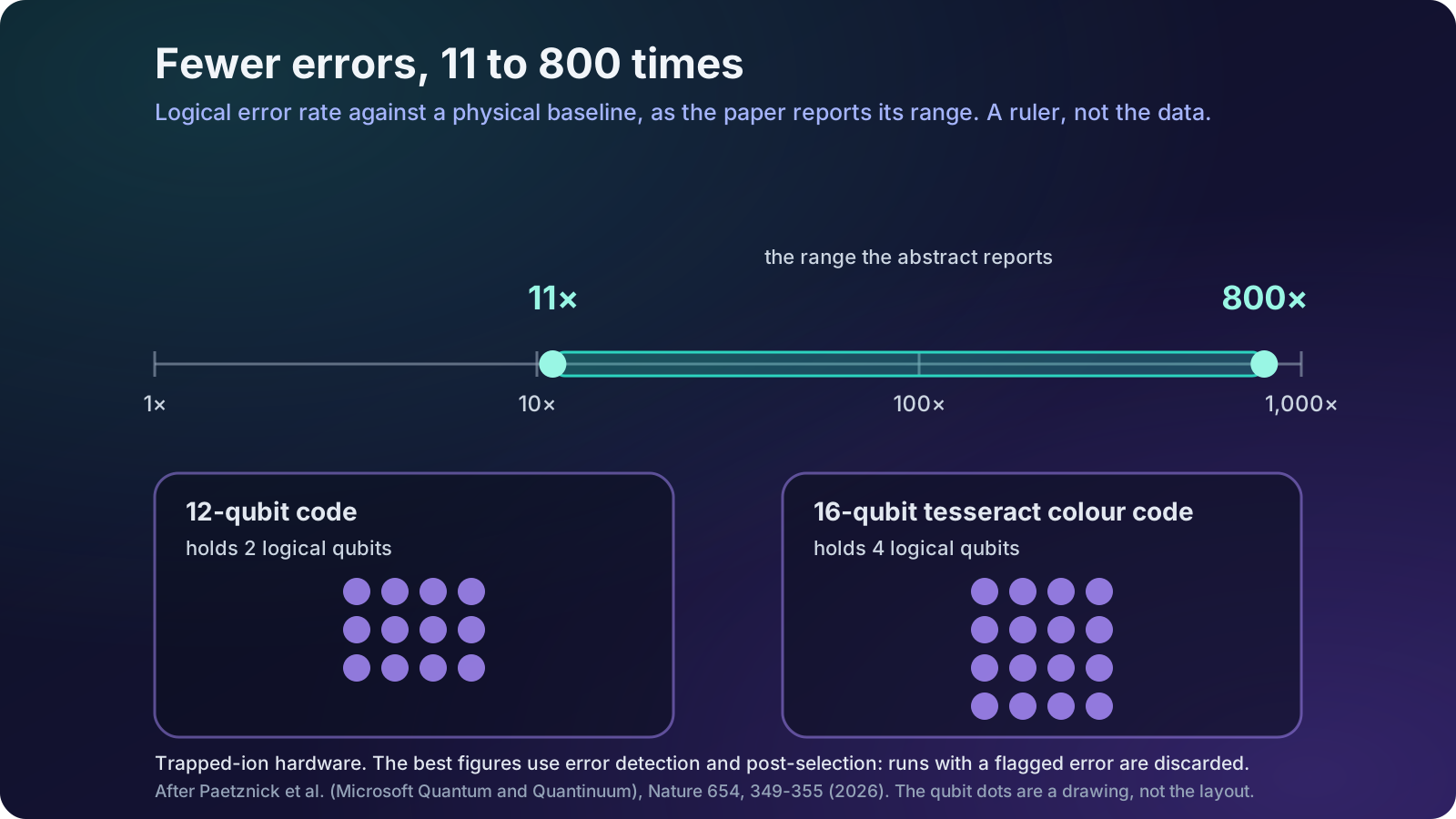
The abstract says logical error rates improved by 11 to 800 times compared with several physical baselines. It names two codes chosen to suit ion traps: a 12-qubit code that holds two logical qubits, and a 16-qubit “tesseract” colour code that holds four. These are combined with a scalable method of error detection and post-selection: when the checks flag a run as suspect, that run is thrown away.
Trade press covering the paper (Quantum Computing Report, The Quantum Insider) gives more detail than the abstract. We have not been able to read the full text, which is behind a paywall, so treat these as reported rather than checked. The 800 times figure is said to come from preparing a Bell state: about 0.8% error on bare qubits against about 0.001% after correction and rejection. Repeated correction is reported at about 51 times lower error per round than the bare baseline, and a 12-qubit cat state at about 22 times lower.
What the figure shows
The figure is a ruler, not the paper’s data. It places the two ends of the range the abstract reports, 11 times and 800 times, on a logarithmic scale, with a drawing of the two codes underneath. The dots are a cartoon of the qubit counts, not the real layout of the ions.
In plain words
Imagine two copies of the same shaky calculation. One runs bare. The other is wrapped in checks, and any run where a check goes off is binned. The wrapped one gives wrong answers far less often. The result is real, and it is a small version of the thing a large quantum computer will need: encoded qubits that are better than the physical ones underneath them.
What this does not show
- The best numbers rely on throwing runs away. Post-selection works on small circuits, but it gets expensive fast. A machine that runs a long computation cannot discard most of its runs. The authors point to scalable alternatives. Reporting says that without the aggressive filtering the improvement is closer to five times, still a gain but a smaller one.
- It is not a fault-tolerant computer. The circuits are small, up to 12 logical qubits in parallel. Reporting also says error signals were interpreted after the run rather than corrected in real time, which a working machine must do.
- It is a comparison with specific baselines. The 11 to 800 range depends on which physical circuit each logical one is compared against. The headline number is the best case.
- One hardware family. These are ions moved around a chip. Whether the same gains carry over to other platforms is a separate question.
Why a reader of this site should care
This is the measuring stick the field is judged by. A claim of “logical qubits” means little until it is set against the bare qubits it was built from, as in what a logical qubit is. The same test sits behind the ETH Zurich lattice surgery result on this desk, and behind the race scoreboard. The Ledger tracks a related dated promise, 24 logical qubits from Atom Computing and Microsoft.
Sources
- Paetznick et al. (Microsoft Quantum and Quantinuum), "Improved quantum processor logical error rates via correction and detection", Nature 654, 349-355 (2026), doi:10.1038/s41586-026-10628-y
- Quantum Computing Report, "Microsoft and Quantinuum publish peer-reviewed quantum error correction data in Nature"
- The Quantum Insider, "Microsoft and Quantinuum report on major gains in quantum error correction" (13 June 2026)
We read the sources above ourselves. Where a figure or number is ours, the article says so. If you find a mistake, tell us: a wrong sentence here gets logged like any other.
More from the research desk
- Quantinuum ran a trapped-ion code below threshold. Its best number is 3 failures in 29,000 tries Quantinuum, company preprint
- Claude designed leaner quantum circuits. The 17x is one comparison Anthropic and Harvard, arXiv preprint
- Google's 99.99% is one magic state, with failed runs thrown away Google Quantum AI, Science
- Error correction inside one atom: a qubit spread over its internal states Nature Physics
- A quantum circuit that comes with a fidelity certificate IBM and the University of Chicago
- Google simulated a tenfold cut in qubit overhead. No chip has run it Google Quantum AI and Google DeepMind, arXiv preprint
- Watching a single phonon jump: the first quantum jumps of sound Stanford University
- Sound waves keep a diamond qubit coherent three times longer Harvard SEAS
- Braiding and fusing anyons gives a full gate set on 54 qubits UChicago, Harvard, Stony Brook and Quantinuum
- Bosonic-code gates in one driving period instead of thousands Chalmers University of Technology
- A flip at the right moment can stop entanglement from dying Raman Research Institute
- Entanglement over 10 km of fibre that lasts longer than it takes to make University of Science and Technology of China
- Splitting one error-corrected qubit into two entangled ones ETH Zurich
- Every paper on the desk