Error correction inside one atom: a qubit spread over its internal states
Instead of spreading a logical qubit over many qubits, a team encoded it in the many internal states of a single trapped ion and corrected errors there. The gains are real and modest.
Usually, one logical qubit costs many physical ones
The standard picture of error correction is a crowd: spread one logical qubit over many physical qubits and let them watch each other. That works, and it is expensive. Dozens or thousands of qubits for one protected one is the number this field keeps quoting, which is why the exchange rate matters so much.
There is an old idea for a different route. A single atom is not a two-level object. It has many internal states. In principle you can use the spare states as the redundancy, and correct errors inside one particle. The authors say this had not been shown experimentally, partly because measuring and fixing errors at high fidelity is hard.
What the paper reports
Kyle DeBry, John Chiaverini, Isaac Chuang and colleagues encode a qubit in a single trapped atomic ion and correct it. The paper, Error correction of a logical qubit encoded in a single atomic ion, appeared as a preprint on arXiv in March 2025 and was published in Nature Physics on 13 July 2026.
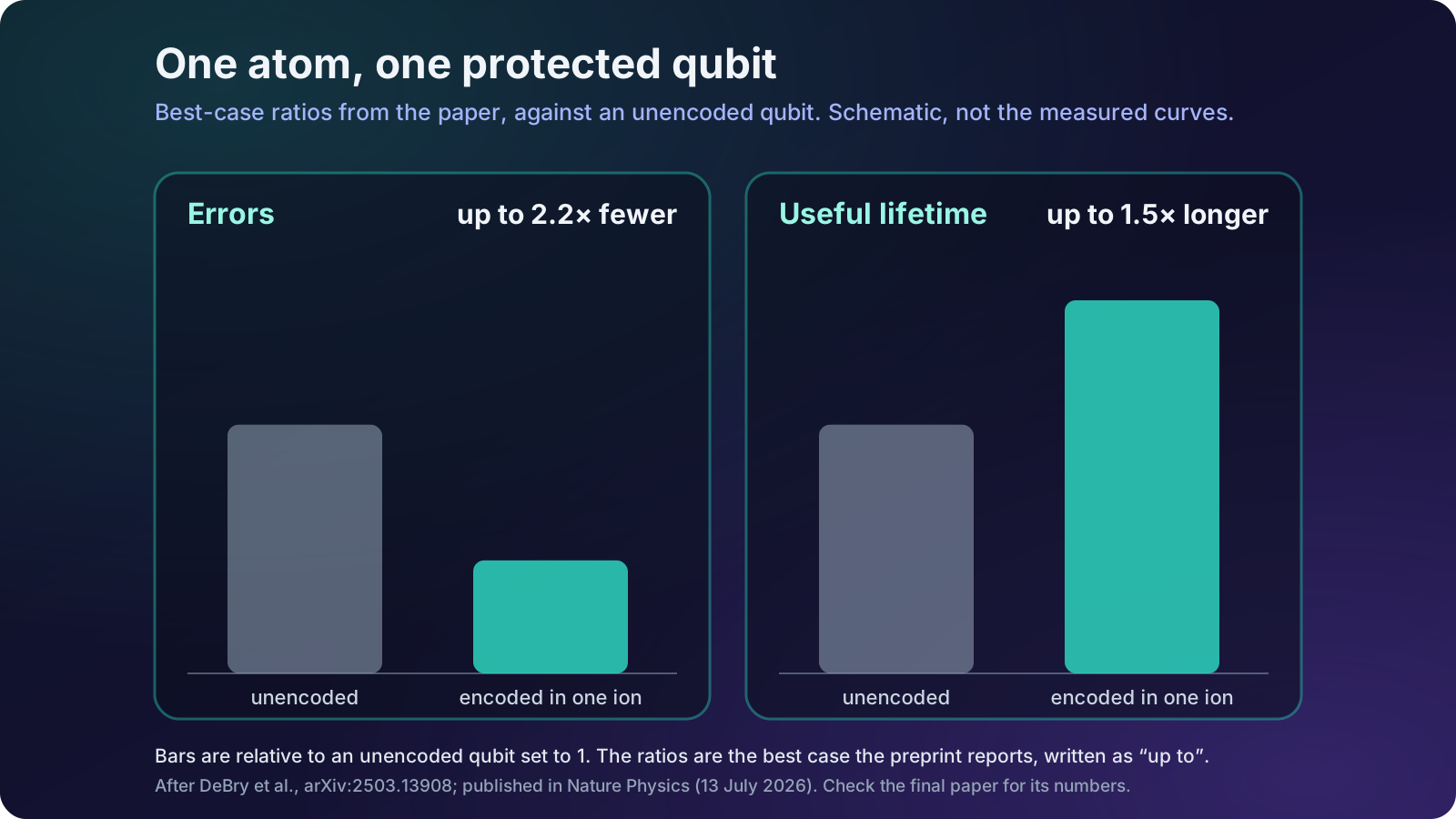
From the preprint’s abstract: the correction decreases errors by a factor of up to 2.2 and extends the qubit’s useful lifetime by a factor of up to 1.5, compared with an unencoded qubit. The logical states are what the paper calls “spin-cat” states. The correction scheme is autonomous: it does not need mid-circuit measurements of a separate helper (ancilla) qubit, which is what normally makes error correction slow and demanding. We quote the preprint’s numbers because the journal page we could read is only a summary; check the final paper for any change.
What the figure shows
The figure is a drawing, not the measured curves. It takes the two best-case ratios from the abstract and draws them as bars against an unencoded qubit set to 1. The error bar is shorter, because there are fewer errors. The lifetime bar is taller, because the qubit lasts longer.
In plain words
A normal qubit is like a coin that is either heads or tails, and any small bump can flip it. Here the information is written into a more elaborate arrangement across the many states one atom can be in. A bump that would have flipped a plain coin now shows up as a recognisable change, and a built-in routine undoes it, without a second qubit standing by to inspect the first.
What this does not show
- The gains are modest, and they are best cases. “Up to 2.2” and “up to 1.5” are the strongest results. They are improvements over an unencoded qubit, not a qubit that stays good indefinitely.
- It is one qubit. Nothing here shows a computer with many such qubits working together. The authors say the idea may be useful as a component of larger codes and in small devices such as network nodes.
- It is a laboratory ion trap. It is a room-sized experiment, not a device.
- It does not replace the crowd approach. It is a different tool, and the paper describes it as a possible building block.
Why a reader of this site should care
The cost of a logical qubit is the central number in the whole race. A route that gets some protection out of one atom is a way to lower it, even if only a little, and it is exactly the kind of idea that might combine with the crowd approach. It also pairs with the Microsoft and Quantinuum result on this desk, which uses ion traps in the other way. For the machine itself see what is inside it.
Sources
- DeBry, Meister, Valdes Martinez, Bruzewicz, Shi, Reens, McConnell, Chuang and Chiaverini, "Error correction of a logical qubit encoded in a single atomic ion", arXiv:2503.13908 (March 2025)
- Nature Physics, same title, published online 13 July 2026, doi:10.1038/s41567-026-03315-2
We read the sources above ourselves. Where a figure or number is ours, the article says so. If you find a mistake, tell us: a wrong sentence here gets logged like any other.
More from the research desk
- Quantinuum ran a trapped-ion code below threshold. Its best number is 3 failures in 29,000 tries Quantinuum, company preprint
- Claude designed leaner quantum circuits. The 17x is one comparison Anthropic and Harvard, arXiv preprint
- Google's 99.99% is one magic state, with failed runs thrown away Google Quantum AI, Science
- Logical errors cut up to 800 times on trapped ions, with a catch Microsoft Quantum and Quantinuum
- A quantum circuit that comes with a fidelity certificate IBM and the University of Chicago
- Google simulated a tenfold cut in qubit overhead. No chip has run it Google Quantum AI and Google DeepMind, arXiv preprint
- Watching a single phonon jump: the first quantum jumps of sound Stanford University
- Sound waves keep a diamond qubit coherent three times longer Harvard SEAS
- Braiding and fusing anyons gives a full gate set on 54 qubits UChicago, Harvard, Stony Brook and Quantinuum
- Bosonic-code gates in one driving period instead of thousands Chalmers University of Technology
- A flip at the right moment can stop entanglement from dying Raman Research Institute
- Entanglement over 10 km of fibre that lasts longer than it takes to make University of Science and Technology of China
- Splitting one error-corrected qubit into two entangled ones ETH Zurich
- Every paper on the desk