A quantum circuit that comes with a fidelity certificate
IBM and University of Chicago researchers build a hard circuit with a structure that lets its fidelity be certified from the machine's own error alarms. It is a preprint, and the certificate is a floor, not a score.
How do you check an answer nobody can compute?
The whole point of a quantum advantage experiment is to run something a classical computer cannot reproduce. That creates an awkward question: if you cannot reproduce the answer, how do you know the quantum computer got it right? Noise is real, and a noisy machine can produce confident-looking nonsense. Past advantage claims were answered by better classical algorithms, so checking matters.
What the preprint reports
A team from IBM, the University of Chicago and others posted Sampling hard circuits with verifiably high fidelity to arXiv on 28 July 2026 (arXiv:2607.25941; the version we read is the revision of 2 September 2026). It is a preprint and has not been peer reviewed.
The idea is to build the circuit with a structure. The authors introduce “structured circuits” that carry provable hardness guarantees and that can be encoded in an error-correcting code. Because of that structure, the syndrome measurements of the code give a way to certify the fidelity of the experiment, meaning how close the final state is to the intended one. The certificate depends on the device, but the authors say it needs weaker assumptions about the noise than existing fidelity proxies.
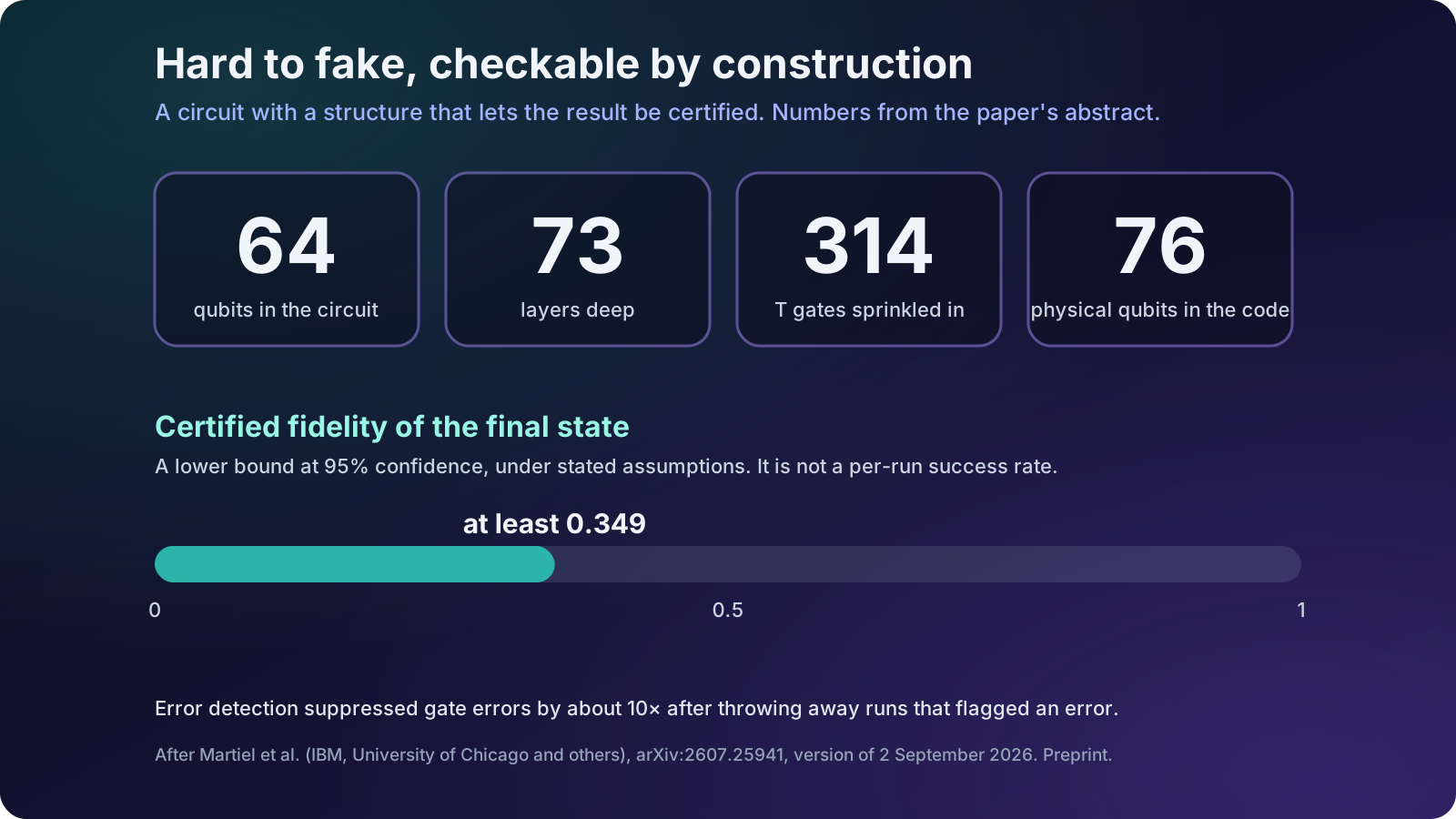
From the abstract, the demonstration is a Clifford circuit on 64 qubits with depth 73, doped with 314 T gates. It is encoded in spacetime codes using 76 physical qubits, which suppresses gate errors by 10 times after syndrome post-selection. The resulting state has a certified fidelity lower bound of 0.349 at 95% confidence. They also give a way to turn a stabilizer state into a magic state while keeping the certificate.
Earlier press coverage of the first version quoted different numbers, because the paper was revised. We use the current abstract only.
What the figure shows
The figure is built only from the abstract. Four boxes carry the circuit’s size. The bar underneath runs from 0 to 1 and marks the certified lower bound of 0.349. The shaded part is what the authors can certify at least, not what they expect the machine reached.
In plain words
Think of a maths test where the answers cannot be looked up. The authors build the test so that most of it is easy to check, and the hard part is slipped in sparingly. They also watch the machine’s own alarm signals during the run. From the alarms and the structure they can say: whatever happened, the final state is at least this close to the right one, assuming the noise behaves in the ways they state. A lower bound is a floor, not a score.
What this does not show
- A floor of 0.349 is far from perfect. It says the state is certifiably far from pure noise. It is not a per-run success rate.
- The certificate has assumptions. It is device-dependent and holds under the noise assumptions the paper states. Weaker than other proxies is not none.
- Throwing runs away costs throughput. The 10 times gain in gate error comes after discarding runs that flagged an error.
- Classical methods can improve. Whether the circuit is out of classical reach is the contested part. The authors are reported to acknowledge that this can change as classical algorithms improve. Independent commentators argue that IBM’s three advantage papers announced on 30 July should not be given equal weight.
- It is not peer reviewed yet, and a certified sampling task is not a useful application. It is not Shor’s algorithm, and it is nowhere near breaking encryption.
Why a reader of this site should care
This is the kind of claim the Ledger exists to follow. IBM has a dated promise about verified quantum advantage by the end of 2026, tracked as its own Ledger entry. We have not issued a verdict on it, and this preprint is evidence to weigh, not a verdict. How to read such claims, including the ones that were later answered classically, is the subject of Advantage Watch. The error-detection tricks used here belong to the same family as the Microsoft and Quantinuum paper on this desk.
Sources
- Martiel, Chung, Seif, Ghosh, Hincks, Deshpande, Manabe, Gu, Pan, Fefferman, Gambetta and Javadi-Abhari, "Sampling hard circuits with verifiably high fidelity", arXiv:2607.25941 (v1 28 July 2026, v3 2 September 2026)
- IBM Newsroom, "IBM and Qedma demonstrate quantum advantage" (30 July 2026)
- PostQuantum.com, "IBM's three quantum advantage papers" (independent commentary)
We read the sources above ourselves. Where a figure or number is ours, the article says so. If you find a mistake, tell us: a wrong sentence here gets logged like any other.
More from the research desk
- Quantinuum ran a trapped-ion code below threshold. Its best number is 3 failures in 29,000 tries Quantinuum, company preprint
- Claude designed leaner quantum circuits. The 17x is one comparison Anthropic and Harvard, arXiv preprint
- Google's 99.99% is one magic state, with failed runs thrown away Google Quantum AI, Science
- Logical errors cut up to 800 times on trapped ions, with a catch Microsoft Quantum and Quantinuum
- Error correction inside one atom: a qubit spread over its internal states Nature Physics
- Google simulated a tenfold cut in qubit overhead. No chip has run it Google Quantum AI and Google DeepMind, arXiv preprint
- Watching a single phonon jump: the first quantum jumps of sound Stanford University
- Sound waves keep a diamond qubit coherent three times longer Harvard SEAS
- Braiding and fusing anyons gives a full gate set on 54 qubits UChicago, Harvard, Stony Brook and Quantinuum
- Bosonic-code gates in one driving period instead of thousands Chalmers University of Technology
- A flip at the right moment can stop entanglement from dying Raman Research Institute
- Entanglement over 10 km of fibre that lasts longer than it takes to make University of Science and Technology of China
- Splitting one error-corrected qubit into two entangled ones ETH Zurich
- Every paper on the desk