Nearly 5,000 mid-circuit checks on up to 100 qubits. A step toward error correction, not error correction
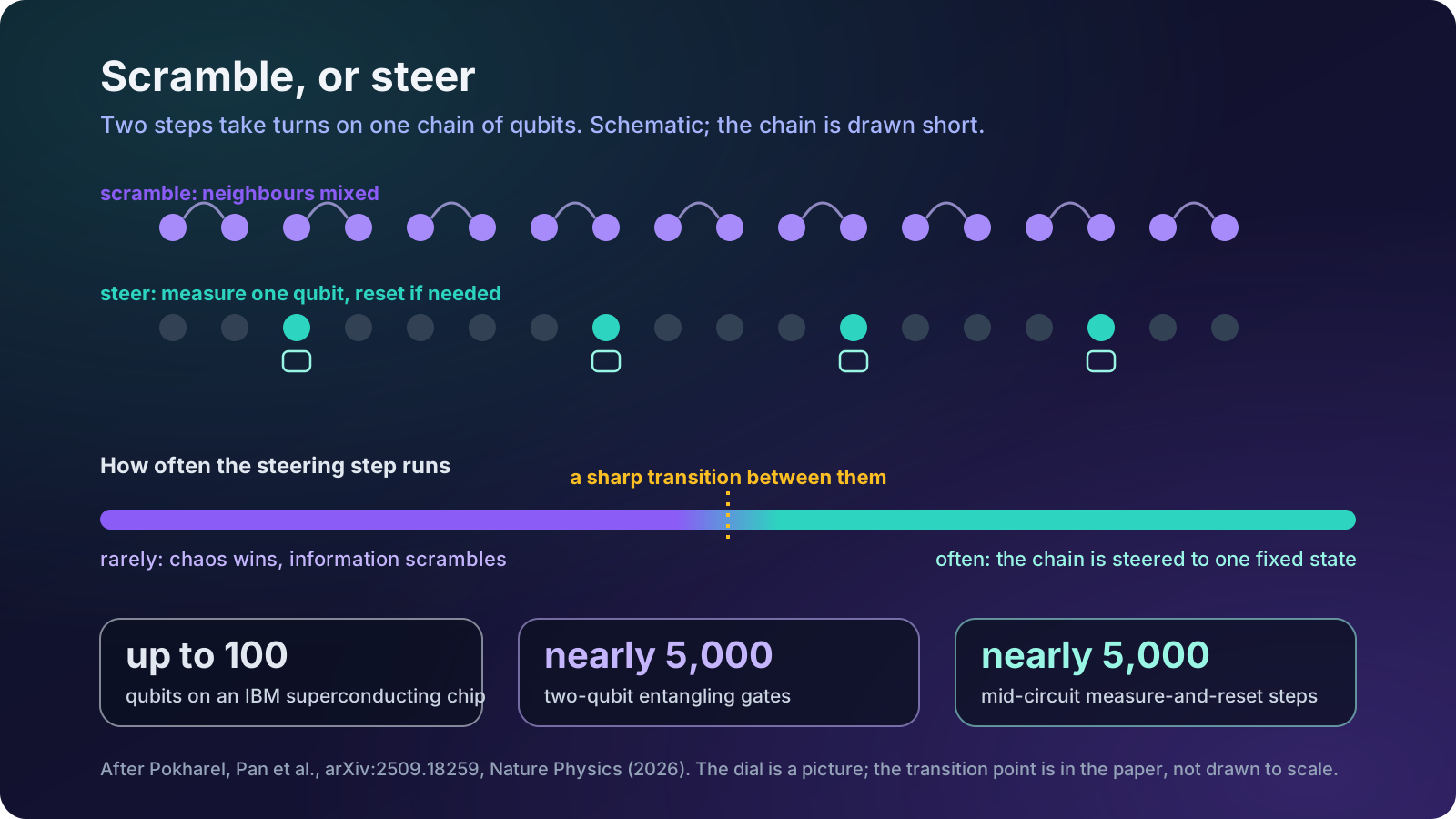
On an IBM superconducting processor, a team from IBM, Rutgers and six other institutions let two steps compete on a chain of up to 100 qubits: one scrambles information between neighbours, the other measures single qubits mid-circuit and resets them. Changing how often each step runs produced a sharp transition between chaotic quantum dynamics and dynamics steered to one fixed state.
Error correction needs a quantum computer that can look and react
Every error-correction scheme works the same way underneath: in the middle of a computation, measure some qubits, decide what the result means, and act on it before carrying on. Each of those mid-circuit measurements disturbs the machine, and doing thousands of them in one run, quickly and cleanly, is a hardware skill in its own right. This experiment tests that skill at a large scale, using a physics question as the test.
What IBM and Rutgers report
The team, with Bibek Pokharel and Haining Pan as first authors and Jedediah Pixley and Maika Takita as senior authors, ran a chain of up to 100 qubits on a 156-qubit IBM Heron superconducting processor. Two steps took turns. One scrambles information between neighbouring qubits, a quantum version of a classically chaotic map. The other measures single qubits mid-circuit and resets them, steering the chain toward one fixed state. In the abstract's words, the circuits applied up to nearly 5,000 entangling gates and 5,000 non-unitary mid-circuit operations.
When the steering step runs rarely, scrambling wins and the dynamics stay chaotic and quantum. When it runs often, the chain is pulled to the fixed state. In between the team saw a sharp transition between the two, one that became more clearly defined in larger systems, and matched it with noisy simulations, matrix product states and statistical-mechanics models. The paper appeared in Nature Physics in October 2026, after an arXiv preprint in September 2025.
What this does not show
- It is not error correction. No logical qubit is encoded and no error rate is pushed down. The paper uses the experiment as a signpost toward fault tolerance, which is fair; headlines that say it “corrects its own mistakes” go further than the work.
- “Up to” is doing work. 100 qubits and nearly 5,000 operations of each kind are the largest runs, not every run.
- What we read. The published paper sits behind a login from where we work. Our numbers come from the arXiv abstract and the university's release. Where the two frame the transition differently, we give neither number and point to the paper.
- A beyond-simulation result about physics, not about usefulness. The release says 100 qubits is far past the roughly two dozen the team could simulate exactly. That is a statement about this model, not a claim of a useful quantum advantage.
Why it matters
Fast measure-and-react cycles are the plumbing of every error-corrected machine on the roadmaps, including IBM's own, tracked on the Ledger. Showing thousands of them in one run on 100 qubits, with the output still making physical sense, is the kind of quiet progress that rarely makes the front page and matters more than most results that do.
Sources
- B. Pokharel, H. Pan, K. Aziz, L. C. G. Govia, S. Ganeshan, T. Iadecola, J. H. Wilson, B. A. Jones, A. Deshpande, J. H. Pixley and M. Takita, "Order from chaos with adaptive circuits on quantum hardware", arXiv:2509.18259 (22 September 2025), the abstract we read
- The published paper, Nature Physics (2026), doi:10.1038/s41567-026-03470-6 (behind a login from here; we did not read the published text)
- Rutgers University, "One step closer to quantum computers that can correct their own mistakes", Phys.org, 12 October 2026
We read the sources above ourselves. Where a figure or number is ours, the article says so. If you find a mistake, tell us: a wrong sentence here gets logged like any other.
More from the research desk
- One error check, measured across two separate quantum computers University of Oxford, arXiv preprint
- One molecule, made by chemists, works as a qubit you can read with light NVision, Ulm University and Hebrew University, arXiv preprint
- Quantinuum ran a trapped-ion code below threshold. Its best number is 3 failures in 29,000 tries Quantinuum, company preprint
- Claude designed leaner quantum circuits. The 17x is one comparison Anthropic and Harvard, arXiv preprint
- Google's 99.99% is one magic state, with failed runs thrown away Google Quantum AI, Science
- Logical errors cut up to 800 times on trapped ions, with a catch Microsoft Quantum and Quantinuum
- Error correction inside one atom: a qubit spread over its internal states Nature Physics
- A quantum circuit that comes with a fidelity certificate IBM and the University of Chicago
- Google simulated a tenfold cut in qubit overhead. No chip has run it Google Quantum AI and Google DeepMind, arXiv preprint
- Watching a single phonon jump: the first quantum jumps of sound Stanford University
- Sound waves keep a diamond qubit coherent three times longer Harvard SEAS
- Braiding and fusing anyons gives a full gate set on 54 qubits UChicago, Harvard, Stony Brook and Quantinuum
- Bosonic-code gates in one driving period instead of thousands Chalmers University of Technology
- A flip at the right moment can stop entanglement from dying Raman Research Institute
- Entanglement over 10 km of fibre that lasts longer than it takes to make University of Science and Technology of China
- Splitting one error-corrected qubit into two entangled ones ETH Zurich
- Every paper on the desk