One molecule, made by chemists, works as a qubit you can read with light
A team mostly at the Ulm company NVision put a triplet-ground-state carbene molecule inside a host crystal of near-identical shape and addressed one molecule at a time with a laser: it initialised, controlled and read out the single molecule's spin, and reported millisecond coherence with dynamical decoupling and tens of milliseconds of spin relaxation at 4.5 K.
Qubits you can build atom by atom
A quantum network needs qubits that keep their state for a long time and can be read and linked with light. Today's best candidates in solids are defects in crystals, like the nitrogen-vacancy centre in diamond. They work, but every defect sits in a slightly different spot and no two are quite alike. Molecules offer a different deal: a chemist can make billions of identical copies and tune the structure on purpose. The catch has been that no molecule combined bright, stable light with a spin that lasts, so nobody could read a single molecular qubit optically.
What the NVision team reports
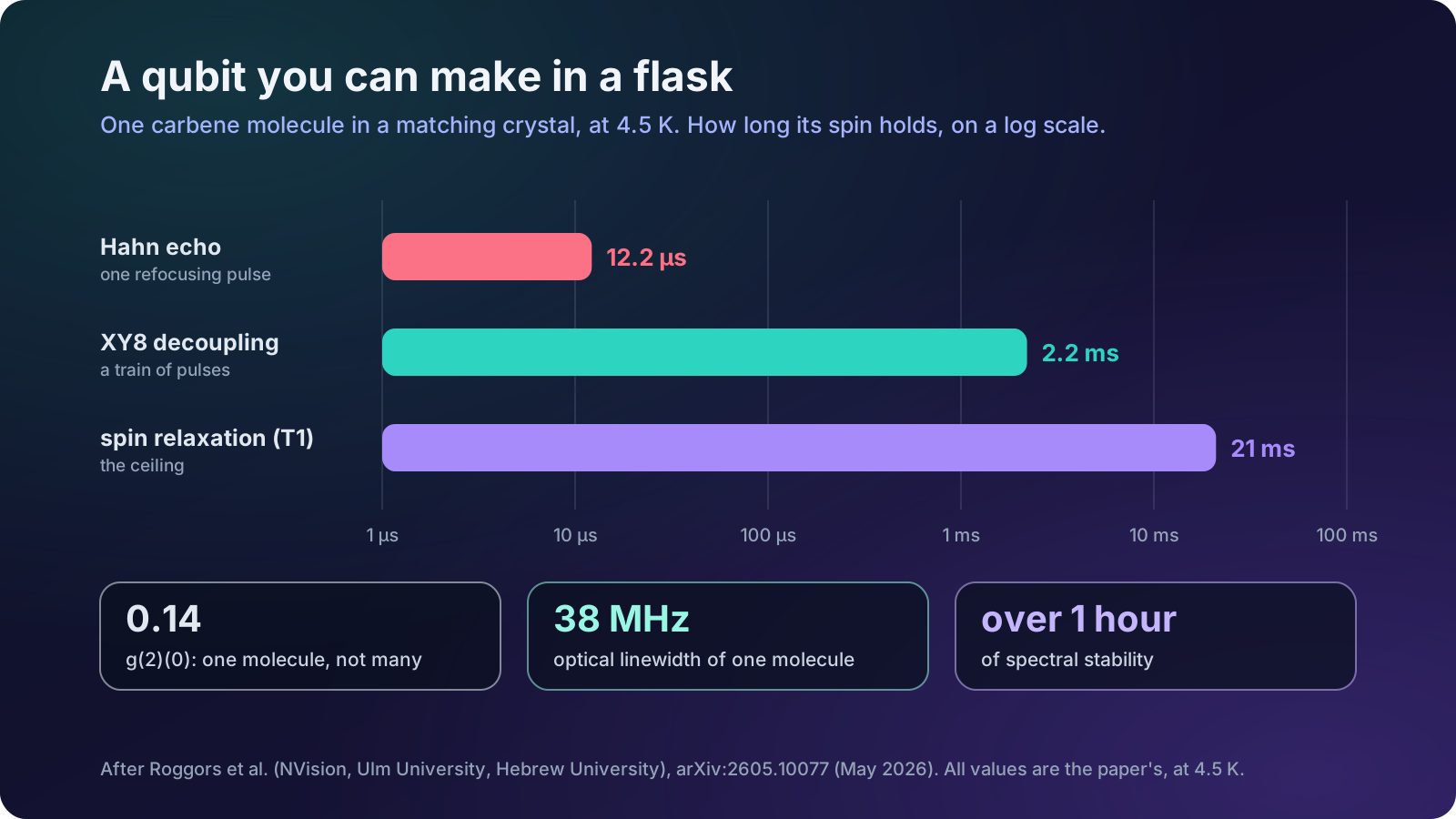
Researchers mostly at the Ulm company NVision, with Ulm University and the Hebrew University of Jerusalem, used a triplet-ground-state carbene, a molecule whose ground state carries a spin, set inside a host crystal of almost the same shape. Cooled to 4.5 K, single molecules could be picked out one at a time: the light passed the single-emitter test with g(2)(0) = 0.142, the optical line of one molecule was 38(2) MHz wide, and it stayed put to within about 2.5 MHz for more than an hour.
They then initialised, controlled and read out the spin of one molecule with light. Its coherence under a simple Hahn echo was 12.2(6) µs; under XY8 dynamical decoupling, a train of refocusing pulses, it reached 2.2(3) ms; spin relaxation, the ceiling on all of this, was 21(2) ms.
What this does not show
- No spin-photon entanglement yet. The paper is titled a spin-photon interface and it does read the spin with light, but entangling the spin with an emitted photon, the step a network needs, is described as a future route.
- Cold, not warm. Everything is at 4.5 K. The authors note the carbene becomes unstable around room temperature.
- Milliseconds need help. The 2.2 ms is with thousands of decoupling pulses. Left alone, the spin loses its phase in about 12 µs.
- A preprint, from a company. Posted on arXiv in May 2026, not yet peer-reviewed, and most authors work for NVision, which develops molecular qubits commercially. We found one inconsistency in the text, the doping level, given as 25 ppm in one place and 2.5 mol% in another.
Why it matters
It opens a third family of optically addressable spin qubits next to atoms and crystal defects, one that can in principle be designed on paper and made in bulk. Whether it beats diamond for networks depends on the entanglement step still to come. For how coherence times are measured and why decoupling pulses stretch them, see the basics and our note on a diamond qubit kept coherent by sound.
Sources
- S. Roggors, T. Unden, A. Aubele et al., "A Single-Molecule Spin-Photon Interface", arXiv:2605.10077, submitted 11 May 2026 (v1, the version we read)
- The same paper, full text (HTML)
We read the sources above ourselves. Where a figure or number is ours, the article says so. If you find a mistake, tell us: a wrong sentence here gets logged like any other.
More from the research desk
- One error check, measured across two separate quantum computers University of Oxford, arXiv preprint
- Nearly 5,000 mid-circuit checks on up to 100 qubits. A step toward error correction, not error correction IBM Quantum and Rutgers, Nature Physics
- Quantinuum ran a trapped-ion code below threshold. Its best number is 3 failures in 29,000 tries Quantinuum, company preprint
- Claude designed leaner quantum circuits. The 17x is one comparison Anthropic and Harvard, arXiv preprint
- Google's 99.99% is one magic state, with failed runs thrown away Google Quantum AI, Science
- Logical errors cut up to 800 times on trapped ions, with a catch Microsoft Quantum and Quantinuum
- Error correction inside one atom: a qubit spread over its internal states Nature Physics
- A quantum circuit that comes with a fidelity certificate IBM and the University of Chicago
- Google simulated a tenfold cut in qubit overhead. No chip has run it Google Quantum AI and Google DeepMind, arXiv preprint
- Watching a single phonon jump: the first quantum jumps of sound Stanford University
- Sound waves keep a diamond qubit coherent three times longer Harvard SEAS
- Braiding and fusing anyons gives a full gate set on 54 qubits UChicago, Harvard, Stony Brook and Quantinuum
- Bosonic-code gates in one driving period instead of thousands Chalmers University of Technology
- A flip at the right moment can stop entanglement from dying Raman Research Institute
- Entanglement over 10 km of fibre that lasts longer than it takes to make University of Science and Technology of China
- Splitting one error-corrected qubit into two entangled ones ETH Zurich
- Every paper on the desk