One error check, measured across two separate quantum computers
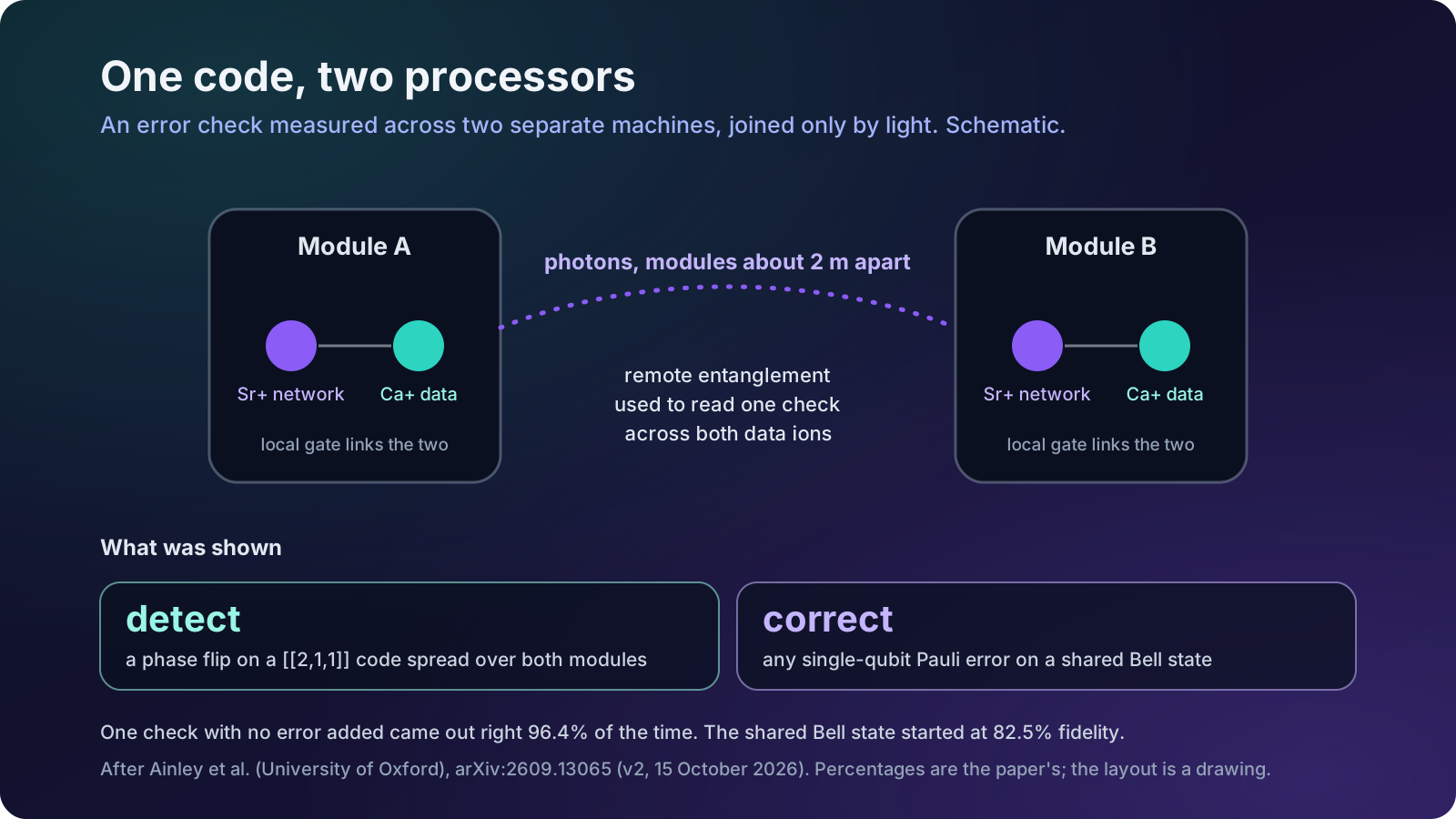
Oxford's two-module ion-trap machine used entanglement made over a photonic link to measure a stabiliser on data qubits sitting in different processors. It detected phase flips on a logical qubit spread over both modules, in real time, and corrected any single-qubit Pauli error on a Bell state shared between them.
One box will not hold a useful machine
A quantum computer that can run useful algorithms will need many thousands of physical qubits, and an error-corrected one needs them to check each other constantly. No single ion trap or chip is expected to hold all of them. One answer is to build smaller modules and join them with light: each module sends photons down a fibre, and the photons leave qubits in different modules entangled. The open question has been whether error correction, the checks that keep a logical qubit alive, can actually be measured across that gap.
What Oxford reports
A University of Oxford team led by Ellis Ainley, Gabriel Araneda and David Lucas used two trapped-ion modules about 2 m apart. Each holds a strontium ion that talks to the photonic link and a calcium ion that holds the data. Entanglement made over the link let them measure a stabiliser, one of the parity checks an error-correcting code is built from, on data qubits sitting in two different processors. The paper describes this as the first experimental demonstration of distributed quantum error detection and correction.
Two experiments. First, a [[2,1,1]] repetition code, one logical qubit spread over both modules, with phase flips detected in real time: when the check flags an error, the run is aborted and the logical qubit is prepared again. Second, the same remote checks combined with real-time feedforward to correct any single-qubit Pauli error on a Bell state shared between the modules. With no error added, one check gave the right answer 96.4(6)% of the time; the shared Bell state was prepared at 82.5(15)% fidelity. Each data point is 1,000 runs.
What this does not show
- The codes are as small as codes get. A two-qubit repetition code detects one kind of error and cannot fix it; the correction experiment protects a Bell state, not an arbitrary logical qubit. The authors note that protecting an arbitrary logical superposition this way needs at least five physical qubits.
- Not good enough yet, in the authors' words. They write that the fidelities “are not sufficient for typical fault-tolerant implementations”, limited mainly by the local gates between the two ion species and by the quality of the network link.
- Speed. Making remote entanglement is slow next to the gates inside a module, and the authors flag network latency as a cost that can dominate an error-correction cycle.
- A preprint. This is on arXiv, revised on 15 October 2026, and has not yet been through peer review.
Why it matters
Most of the field's roadmaps now assume modules joined by light, and the codes that save the most qubits need checks between qubits that are far apart. Until a check had been measured across two machines, that plan rested on theory. This is the proof of principle: small and noisy, and the first of its kind on our desk. The ion-trap side of the race is on our race page, and remote entanglement in ion traps also appears in our note on 10 km of fibre.
Sources
- E. M. Ainley, A. Agrawal, T. Araki et al., "Error Correction in a Distributed Quantum Computer", arXiv:2609.13065, submitted 11 September 2026, revised 15 October 2026 (the version we read)
- The same paper, full text (HTML)
- University of Oxford Department of Physics, ALP seminar: "Error correction in a distributed quantum computer"
We read the sources above ourselves. Where a figure or number is ours, the article says so. If you find a mistake, tell us: a wrong sentence here gets logged like any other.
More from the research desk
- Nearly 5,000 mid-circuit checks on up to 100 qubits. A step toward error correction, not error correction IBM Quantum and Rutgers, Nature Physics
- One molecule, made by chemists, works as a qubit you can read with light NVision, Ulm University and Hebrew University, arXiv preprint
- Quantinuum ran a trapped-ion code below threshold. Its best number is 3 failures in 29,000 tries Quantinuum, company preprint
- Claude designed leaner quantum circuits. The 17x is one comparison Anthropic and Harvard, arXiv preprint
- Google's 99.99% is one magic state, with failed runs thrown away Google Quantum AI, Science
- Logical errors cut up to 800 times on trapped ions, with a catch Microsoft Quantum and Quantinuum
- Error correction inside one atom: a qubit spread over its internal states Nature Physics
- A quantum circuit that comes with a fidelity certificate IBM and the University of Chicago
- Google simulated a tenfold cut in qubit overhead. No chip has run it Google Quantum AI and Google DeepMind, arXiv preprint
- Watching a single phonon jump: the first quantum jumps of sound Stanford University
- Sound waves keep a diamond qubit coherent three times longer Harvard SEAS
- Braiding and fusing anyons gives a full gate set on 54 qubits UChicago, Harvard, Stony Brook and Quantinuum
- Bosonic-code gates in one driving period instead of thousands Chalmers University of Technology
- A flip at the right moment can stop entanglement from dying Raman Research Institute
- Entanglement over 10 km of fibre that lasts longer than it takes to make University of Science and Technology of China
- Splitting one error-corrected qubit into two entangled ones ETH Zurich
- Every paper on the desk